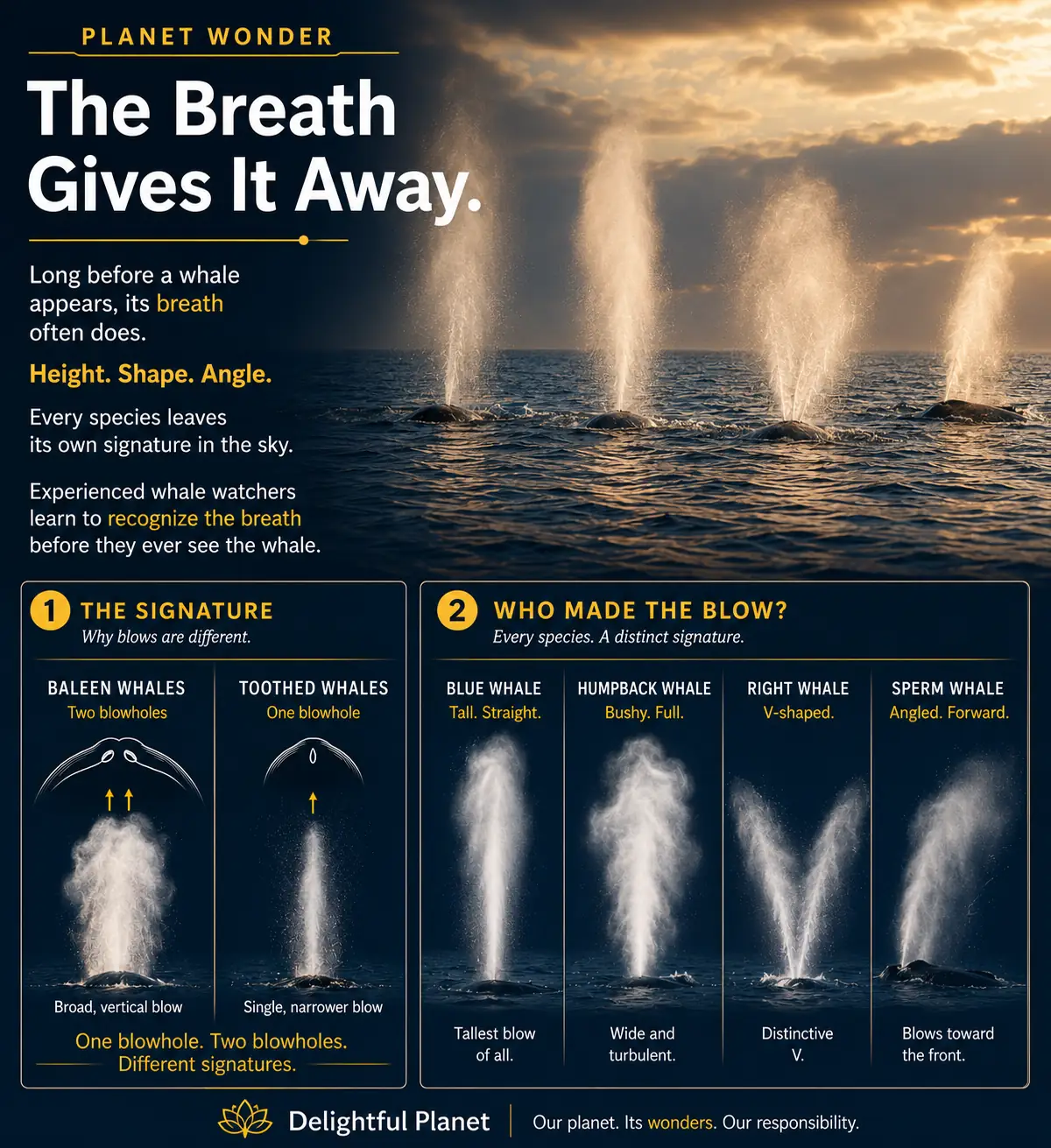
Long before a whale appears at the surface, something else does. The blow erupts first — a column or cloud of condensed breath rising against the sky — visible from kilometers away, announcing the animal before its body is even visible. Experienced whale watchers and researchers don't wait for the animal. They read the breath. Every species has a signature, and the signature is specific enough to identify the whale before any other feature comes into view.
The mechanismThe shape of a whale's blow is determined by three things: the structure of the blowhole, the lung volume and respiratory force behind the exhalation, and the speed at which air exits. Baleen whales have two blowholes set side by side — their exhale produces either a single broad plume or, in species where the two openings are widely spaced, a distinct V-shape. Toothed whales have a single blowhole, producing a single narrower column. The angle of the blow is fixed by anatomy: a sperm whale's blowhole sits offset to the left on the front of its head, so its blow angles forward and to the left every time, without exception. These features are consistent within a species and distinctive between them.
The four species on the poster illustrate the range. The blue whale produces the tallest blow of any whale species — a narrow, nearly vertical column that can reach nine meters on a calm day, visible from several kilometers. The humpback's blow is low and wide, often described as balloon-shaped, reaching around three meters but spreading broadly — nearly as wide as it is tall. The North Atlantic right whale produces a distinctive V-shaped double blow, its two widely separated blowholes creating two clearly separate jets that angle outward from each other. The sperm whale's single blow angles distinctively forward and to the left, typically reaching around three meters — lower than a baleen whale its size, and unmistakably angled.
In field conditions — rolling seas, variable light, distances of a kilometer or more — blow identification is often the first and only reliable signal that a whale is present, and frequently the only way to assign a species before the animal dives again. Whalers understood this for centuries: their logbooks recorded blow shape as a primary species identifier, allowing them to select targets at distance. Researchers today use the same principle, now combined with drone surveys and automated image analysis, to conduct population counts and monitor species distribution across ocean basins too large for direct observation. The blow is what makes an animal of this scale detectable from a research vessel before it submerges again in under a minute.
What the blow also reveals
Beyond species identity, the blow carries information about the individual animal. A blow that is lower than typical for the species, or more frequent than usual, may indicate a stressed or exhausted whale — one recovering from a long dive, fleeing a threat, or physiologically compromised. Researchers have documented that blow rate and duration correlate with dive effort and oxygen debt, making surface respiration a proxy for underwater exertion.
The blow also carries biological material — cells, hormones, and microbial communities from deep within the respiratory tract. Drone-collected blow samples from humpback whales have been analyzed for cortisol as a measure of physiological stress, for reproductive hormones to assess breeding status, and for bacterial communities to evaluate respiratory health. The visible plume above the surface is also an exhaled biological portrait — one that researchers can sample without ever touching the animal.
Blow shape is consistent enough to be used as a primary identification tool, but it is not perfectly invariant. Wind distorts the plume's shape and height. Atmospheric humidity affects how long the condensation cloud persists. A whale that has made a shallow dive will exhale less forcefully than one returning from depth, producing a smaller blow. Individual variation exists within species. The identification skill is probabilistic — experienced observers read the blow as a strong signal, not a definitive one, and confirm with other features when they can.
What makes blow identification remarkable is not that it is perfect but that it works at all. The blow condenses for only a few seconds before dispersing. The animal may already be submerging again by the time an observer focuses on it. The identification happens in real time, at distance, under variable conditions, from a moving vessel, using a cloud of breath that lasts perhaps five seconds. The fact that this is a reliable skill — teachable, learnable, and routinely used — says something precise about how distinct each species' anatomy is. The differences run deep enough that they survive translation into a transient cloud of water vapor, visible for seconds, on the open ocean, from a kilometer away.
The breath was always the giveaway. It took us a while to learn how to read it.
The breath gives it away. And once you know what to look for, you can read it from the horizon.