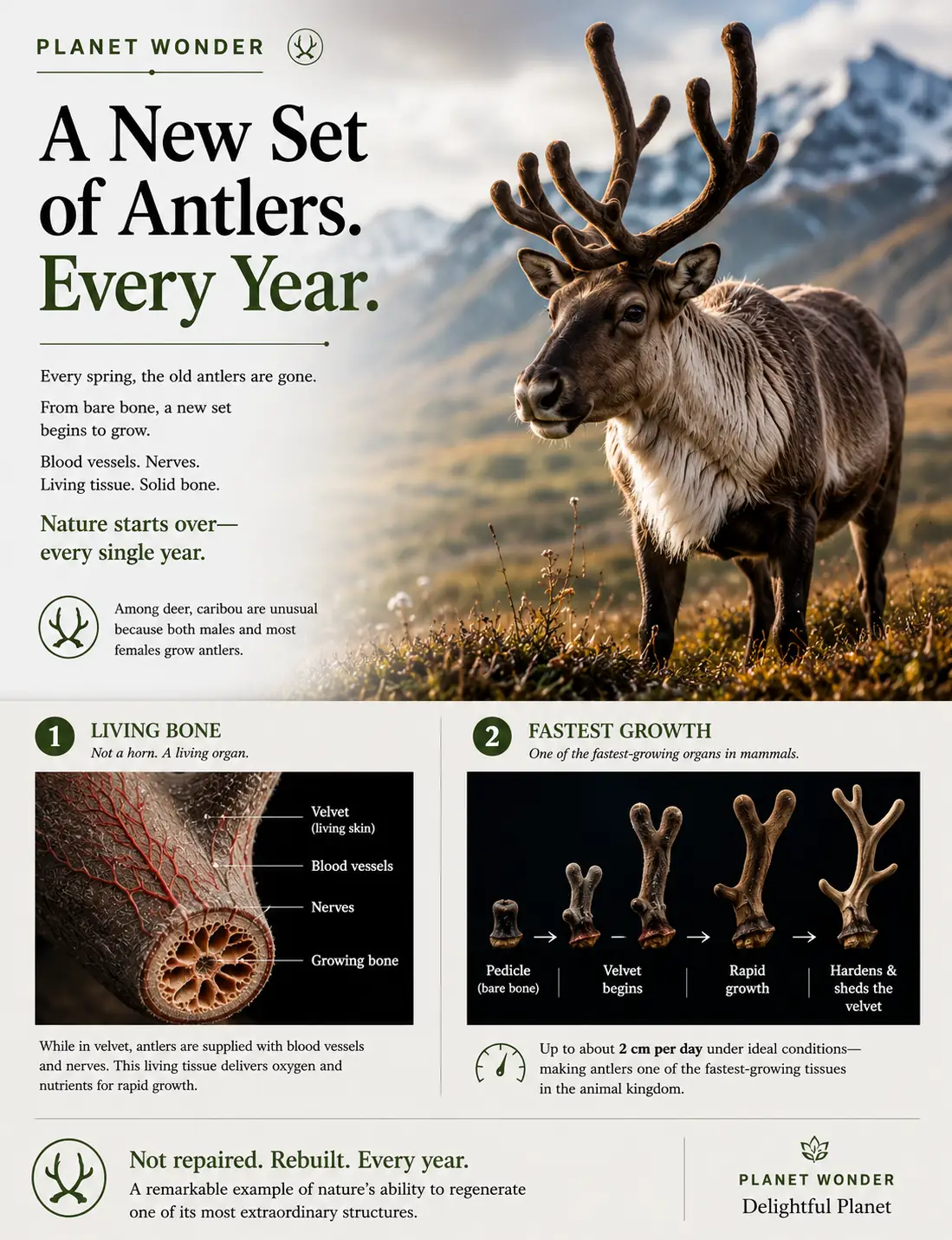
Every spring, a caribou's antlers are gone — shed at the end of the previous season, leaving only the bare pedicle, a permanent bony stump on top of the skull. From that stump, within days, growth begins. By summer the animal carries a full rack of new bone, covered in living tissue, supplied by a network of blood vessels and nerves. The entire structure — which in a large male can span more than a meter and weigh several kilograms — has been built from nothing in a matter of months. Then, in late summer, the growth stops, the tissue dies back, and the antlers harden into the mineralized bone that carries the animal through autumn. The following spring, it starts again.
The mechanismAntlers are not horns. Horns are permanent, made of keratin growing over a bony core, and they are never shed. Antlers are bone — grown, used, and discarded annually — and the only complex mammalian organ capable of complete regeneration. Each cycle begins at the pedicle, a permanent structure fused to the skull from which the antler grows and at which it eventually breaks off. As days lengthen in spring, the changing photoperiod triggers a hormonal cascade — suppressing melatonin, elevating IGF-1 — that drives the pedicle tissue to begin rapid cell division. The growing antler is covered in velvet — a soft skin dense with blood vessels and nerves that delivers oxygen and nutrients directly to the elongating bone below. At peak growth, antlers can extend by up to two centimeters per day, making velvet antler one of the fastest-growing tissues in any mammal.
As days shorten toward autumn, testosterone rises sharply, cutting off blood supply to the velvet. The skin dries, strips away — often rubbed off against trees and shrubs by the animal — and the antler beneath is now fully mineralized bone. This is the antler used in the rut: hard, dense, a weapon and a display. After the breeding season, falling testosterone levels loosen the connection at the pedicle, and the antlers drop. The cycle begins again at the first lengthening of days.
The caribou is the only deer in which both males and females grow antlers — though the prevalence varies by subspecies. In barren-ground caribou, nearly all females grow antlers in most years; in woodland caribou, up to half of females may lack antlers or grow only one. In every other cervid species, antlers are exclusively a male trait, driven by testosterone. Female caribou grow antlers under a different hormonal pathway, one linked not to reproduction but to resource competition. Females retain their antlers through winter, months after males have shed theirs, and use them to defend feeding craters — holes dug through snow to reach lichen beneath — against competitors. A pregnant female with antlers in January has a direct advantage over a male that shed his in November. The antler extends her competitive access to food precisely when she needs it most.
The antler as a mineral bank — new science, February 2026
Research published in Ecology and Evolution in early 2026 by the University of Cincinnati identified a previously undescribed function of female caribou antlers: mineral storage. Female caribou shed their antlers in spring, just days before giving birth — and researchers observed that females, and mothers in particular, regularly gnaw on shed antlers from the calving grounds to recover calcium and phosphorus at precisely the moment their bodies need it most for milk production. The porous bone of the antler stores these minerals during winter foraging and releases them when consumed.
In the cold, dry Arctic, shed antlers can persist on the tundra for hundreds of years without decomposing, providing a standing reserve of minerals. The study proposes that female antlers function as a portable mineral bank — grown in summer, carried through winter and across the migration, shed at the calving ground, and then consumed. The antler is not wasted. It is deposited.
The regenerative biology of antlers has attracted serious attention from biomedical researchers, for two reasons that sit in apparent contradiction. First, antler tissue grows at a rate that would be expected to produce cancer — the rate of cell division during peak velvet growth is comparable to tumor proliferation, and the gene expression profile of antler growth centers resembles osteosarcoma more closely than normal bone. Yet antlers show no cancerous development. They grow rapidly, reorganize constantly, and stop precisely on schedule. Peer-reviewed research in Cell Death and Differentiation (2023) identified this as one of the central puzzles of antler biology: how does a tissue that grows like a tumor consistently fail to become one?
Second, antlers are the only mammalian bony organ capable of complete regeneration. Human bone can heal fractures, but it cannot regrow a lost structure from a stump. The pedicle does exactly this, every year, producing a complex three-dimensional organ of mineralized bone with its own vascular and neural architecture, discarding it, and beginning again. Understanding the molecular controls that allow this — rapid proliferation without malignancy, complete structural regeneration without scar tissue — is now an active area of research in bone repair and regenerative medicine.
The caribou does not think about this. It simply grows the antlers, uses them, sheds them, and grows them again. The biology running beneath that annual cycle is, by any measure, extraordinary — and we are still early in understanding how it works.
A new set of antlers. Every year. From nothing.