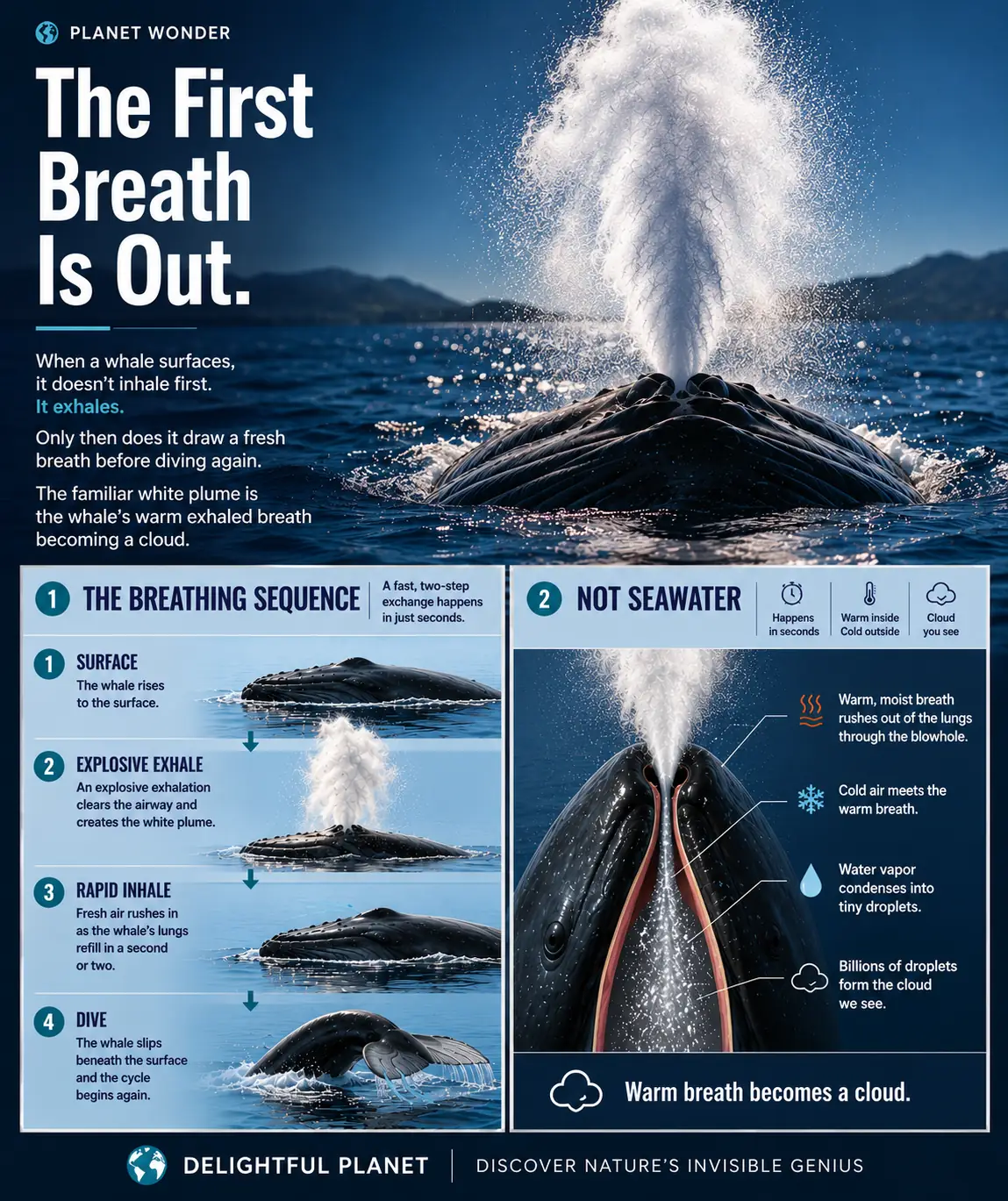
The white plume appears before anything else. Before the whale is fully visible at the surface, before it takes its next breath, before it shows its shape — the blow erupts upward, sometimes nine meters into the air, visible from miles away. Every whale watcher knows it as the moment of sighting. Almost nobody registers what it actually is: not the breath coming in, but the breath going out — the entire contents of the whale's lungs, expelled in under a second, condensing into a cloud as it hits the cold air above the water.
The mechanismThe sequence is exhale-first, always. As the whale rises toward the surface, its blowhole — the muscular valve at the top of its head — remains sealed. The moment it breaks the surface, the valve opens and the whale exhales with enormous force, emptying up to 90 percent of its lung volume in a single explosive breath. The stale air from the previous dive rushes out through the blowhole at high speed, clearing the airway completely. Only then, in the brief seconds the whale spends at the surface, does it inhale — refilling its lungs before the blowhole seals again and the whale submerges.
The white plume is the exhale made visible. The air leaving the whale's lungs is warm — close to body temperature — and saturated with water vapor. When it meets the cooler atmosphere above the ocean, the vapor condenses instantly into a fine cloud of water droplets, the same physics that makes breath visible on a cold day. The plume also contains mucus and oil droplets from the whale's respiratory tract, which is why it is denser and more visible than a simple water vapor cloud. The size, height, and angle of the blow varies by species: the blue whale's rises nearly vertically up to nine meters; the sperm whale's angles distinctively forward and to the left because its single blowhole is offset on the front-left of its head.
The exhale-first sequence is a solution to the constraints of breath-hold diving. A whale surfacing with lungs full of spent air cannot simply top up — it needs to clear the old air entirely before the new breath is useful. Exhaling first accomplishes this in the minimum possible time at the surface: one explosive out-breath, one rapid in-breath, and the whale is ready to dive again. The entire gas exchange — out and in — can happen in under two seconds in some species. Humans, breathing involuntarily and continuously, exchange roughly 10 to 15 percent of lung air with each breath. Whales exchange 80 to 90 percent in a single deliberate cycle. Every breath is a complete reset.
A breath that has to be chosen
Whales breathe voluntarily — every breath is a conscious act. Unlike humans, who breathe automatically and involuntarily, a whale must choose to breathe. This means the whale must maintain enough awareness to surface and open its blowhole, even when sleeping. Cetaceans solve this through unihemispheric slow-wave sleep: one hemisphere of the brain rests while the other stays alert, allowing the animal to continue basic functions — including surfacing to breathe — while partially asleep.
The blowhole itself is a highly modified nasal opening, homologous to the nostrils of land mammals, that migrated to the top of the head over tens of millions of years of cetacean evolution. In baleen whales it is paired — two openings side by side — giving the blow its characteristic double-plume shape. In toothed whales, including sperm whales and dolphins, there is a single blowhole. The muscular nasal plug sealing it is passively closed at rest — no effort required to keep it shut. Opening the blowhole requires active muscular contraction, pulling the nasal plug back and spreading the blowhole margins to allow air through. The seal closes again the moment those muscles relax.
The blow is also a diagnostic tool. Each whale species produces a blow with a distinctive shape and height — reliable enough that experienced observers can identify species from the blow alone, before seeing any other feature of the animal. The blue whale's tall, narrow column differs from the humpback's shorter, bushier plume; the right whale produces a distinctive V-shaped double blow from its paired blowholes. Whalers historically used blow shape to identify target species from great distances. Researchers today use the same characteristic, combined with drone-mounted petri dishes, to collect exhaled breath samples — containing cells, hormones, and microbial communities from the respiratory tract — without disturbing the animal.
That breath has become a research medium in its own right. Studies of humpback whale blow samples have identified 25 microbial species in a single exhalation, distinct from the surrounding seawater — evidence of a whale-specific respiratory microbiome. Blow samples have been used to measure cortisol levels as a stress indicator, to detect reproductive hormones, and to assess respiratory health in free-ranging whales without capture. The cloud that erupts from the whale's head contains, in compressed form, a detailed biological portrait of the animal that produced it.
For an animal that must breathe air, live in water, and move between the two continuously, every surface encounter is a precision operation: get in, clear the lungs, refill, get out. The blow that signals the whale's presence is not a flourish or an accident. It is the moment the system resets — so the animal can go back down.
The first breath is out. And everything else follows from that.