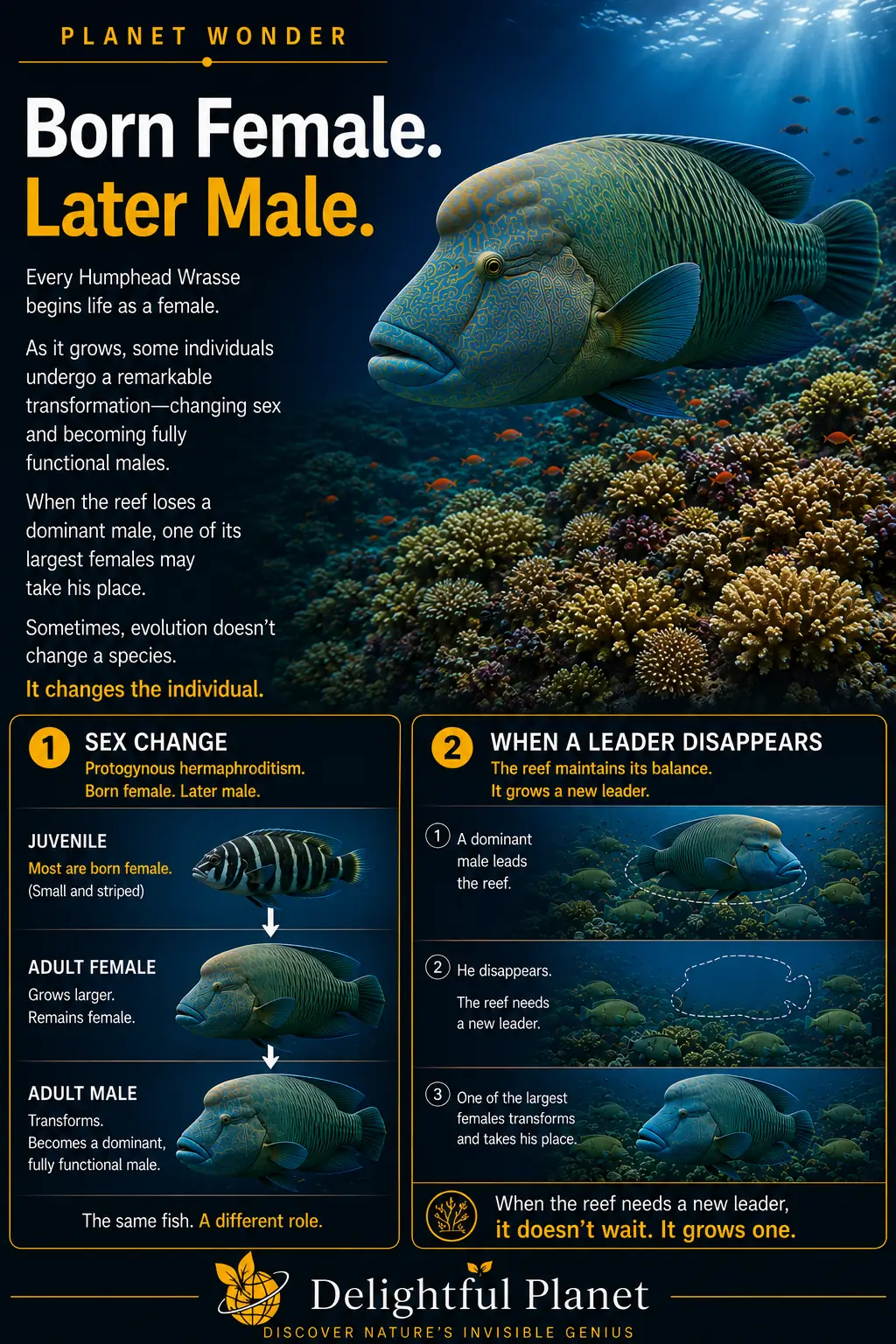
On a coral reef in the Indo-Pacific, one of the largest fish you will encounter is almost certainly a male Humphead Wrasse — a creature that can reach two meters in length and weigh close to 190 kilograms, wearing a massive bulge on its forehead like a badge of authority. What is less obvious from a distance is that this male began its life as a female. And that if it were to disappear tomorrow, one of the females on the reef would begin the process of becoming male to replace it.
The mechanismThe Humphead Wrasse is a protogynous hermaphrodite — from the Greek for "female first." Every individual matures initially as a female, reaching sexual maturity at around five to seven years of age. Some, as they grow larger and older, undergo a complete transformation: ovaries reorganize into testes, coloration shifts, the forehead hump develops further, and behavior changes to match. The fish that emerges is a fully functional male, capable of fertilizing eggs. The trigger for this transformation is not age alone — it is social. When a dominant male disappears from the group, the largest, most dominant female begins to change.
The molecular mechanism underlying socially cued sex change has been studied in detail in related wrasse species. The perception of the dominant male's absence registers as a social stress — cortisol rises in the largest female, initiating a cascade that shuts down the aromatase gene, the enzyme responsible for converting androgens to estrogen. As estrogen production collapses, the feminizing genetic network falls apart and a masculinizing network takes its place. Ovarian tissue undergoes atresia and is progressively replaced by testicular tissue. Behavioral changes — aggression, territorial display, courtship — precede the gonadal changes by days. The fish begins acting male before it has finished becoming one.
The system is a solution to a specific reproductive problem. In a low-density population scattered across a large reef, having a reliable male present to fertilize eggs at all times is not guaranteed if sex is fixed at birth. Protogynous hermaphroditism solves this: the largest, most competitive individual in the group becomes male, because large males can defend territories and outcompete rivals more effectively than large females can outcompete other females for reproductive opportunities. Size favors maleness more than femaleness. When the male is gone, the group produces a new one from within — no recruitment required, no vacancy left unfilled.
The largest wrasse — and one of the most threatened
The Humphead Wrasse is the largest member of the wrasse family Labridae, reaching lengths exceeding two meters and weights up to 190 kilograms. It lives for up to 30 years and does not reach sexual maturity until five to seven years of age — a slow life history that makes population recovery extremely difficult once numbers decline.
It is listed as Endangered on the IUCN Red List and in Appendix II of CITES. The primary threat is the live reef food fish trade, where large individuals command thousands of dollars each in Hong Kong and mainland China markets. The protogynous sex change system compounds the vulnerability: fishing pressure disproportionately targets the largest individuals — which are the males — removing the very fish the reproductive system depends on to function. When males are systematically removed, the sex ratio skews female, reproduction collapses, and the population's own repair mechanism is disabled.
Sex change of this kind — complete, functional, socially triggered — challenges a deeply held assumption that sex is a fixed property of an organism, written in its chromosomes and unalterable thereafter. In the Humphead Wrasse, and in the hundreds of other fish species capable of sequential hermaphroditism, sex is better understood as a developmental state that can be reset under the right conditions. The genetic machinery for both sexes is present in every individual. What determines which is expressed is not the genome alone but the social environment the fish inhabits.
The implications for developmental biology are significant. Research on wrasse sex change has identified that the transition does not proceed by direct transdifferentiation — one tissue type converting directly into another. It passes through an intermediate state whose molecular signature resembles that of early pluripotent cells, a period of reprogramming before the new identity is established. The ovary does not simply become a testis. It first becomes something more plastic, and then resolves into the new form. The process is, in a structural sense, closer to development than to conversion.
For a fish that can live thirty years and whose sex is determined not by chromosomes but by circumstance, the question of what it means to have a fixed biological identity has a different answer than it does for most vertebrates. The Humphead Wrasse does not have a fixed sex. It has a current one — and the reef, when it needs to, can change it.
Every Humphead Wrasse is born female. Some become male. The reef decides which.