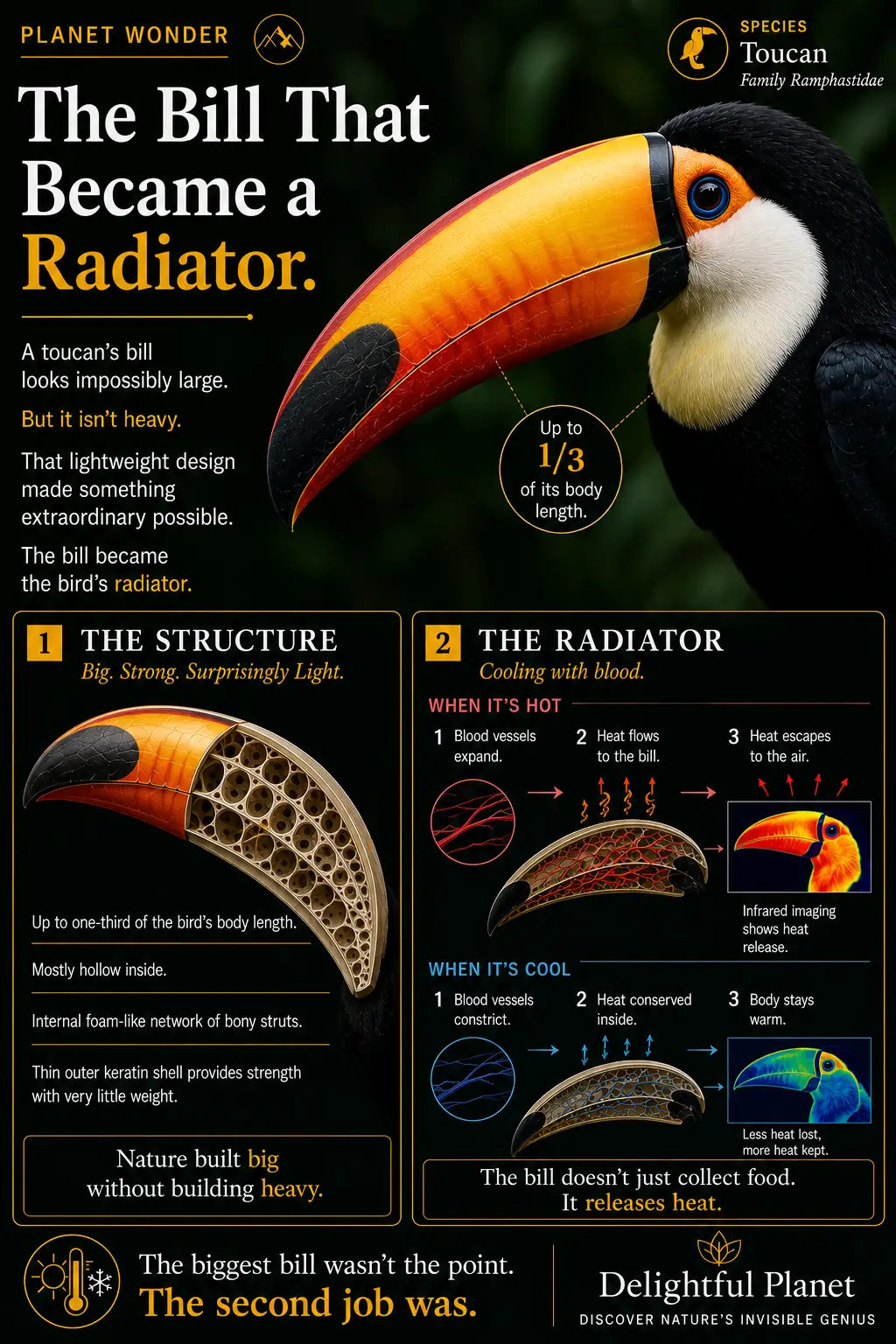
The toco toucan's bill is up to one-third of its total body length — the largest bill relative to body size of any bird. It is immediately striking and has attracted explanations ranging from sexual ornament to feeding tool. But in 2009, a research team led by Glenn Tattersall at Brock University published a paper in Science that demonstrated something nobody had measured before: the bill is also one of the most effective heat exchange organs in the animal kingdom, capable of dumping or conserving body heat on demand by controlling blood flow.
The mechanismThe bill's thermoregulatory function depends on two properties working together: a large, uninsulated surface area and a dense network of blood vessels running close to that surface. When the toucan is too warm, blood vessels in the bill dilate, increasing flow to the surface. Heat from the blood passes through the thin keratin shell into the surrounding air — the bill acts as a radiator, shedding body heat without the bird needing to pant or sweat. When the bird needs to conserve heat, the vessels constrict, blood flow to the bill drops, and heat loss is sharply reduced. The same structure serves opposite functions, switching between them in response to ambient temperature.
Tattersall's team used infrared thermography — imaging technology that maps surface temperature — to document this in real time, exposing birds to air temperatures from 10°C to 35°C and recording the bill's surface temperature throughout. The results showed the bill surface temperature tracking ambient conditions closely: hot outside, hot bill; cold outside, cool bill. The paper found the bill can account for as much as 100% of the bird's resting heat production when conditions demand maximum heat loss. At sunset, the effect was particularly striking — birds pumped heat from the bill within minutes of roosting, lowering body temperature as they transitioned into sleep.
The bill's structure is what makes this possible at large scale. The interior is mostly hollow — a foam-like network of bony struts provides structural support without mass, and a thin outer keratin shell provides the surface. The result is a structure that is anatomically large enough to function as a significant heat exchanger while being light enough not to unbalance the bird. According to the Science paper, the bill surface can represent between 30 and 50% of the bird's total body surface area. That is an enormous thermal window — comparable, the paper notes, to the surface area of an elephant's ear relative to its body.
One bill, several explanations — and all may be true
Worth being precise here: Tattersall himself and other ornithologists note that thermoregulation alone is not necessarily the primary evolutionary driver of toucan bill size. Sexual selection, foraging reach, fruit handling, and defense are all documented functions. The bill's size may have been shaped by multiple selective pressures simultaneously — thermoregulation being one significant one among several. What the 2009 paper established is that the thermoregulatory function is real, measurable, and substantial — not incidental. The bill is not primarily a radiator that also handles food. It is a multifunctional structure in which thermoregulation plays a major documented role.
The toucan bill is one of several structures across the animal kingdom that serve as controllable thermal windows — uninsulated, vascularized surfaces through which heat exchange can be actively regulated. Elephant ears, rabbit ears, and the bills of many other bird species serve similar functions at smaller scales. What distinguishes the toucan is the sheer size of the surface area relative to body mass, and the precision of the control — a surface that can switch from maximum heat dissipation to near-complete conservation within minutes, driven entirely by vascular adjustment.
The engineering insight is that the bill's apparent excess — too large, too conspicuous, seemingly disproportionate — is not excess at all. It is capacity. The biggest bill wasn't the point. The second job was.
The bill collects food. It also releases heat. Both, on demand.