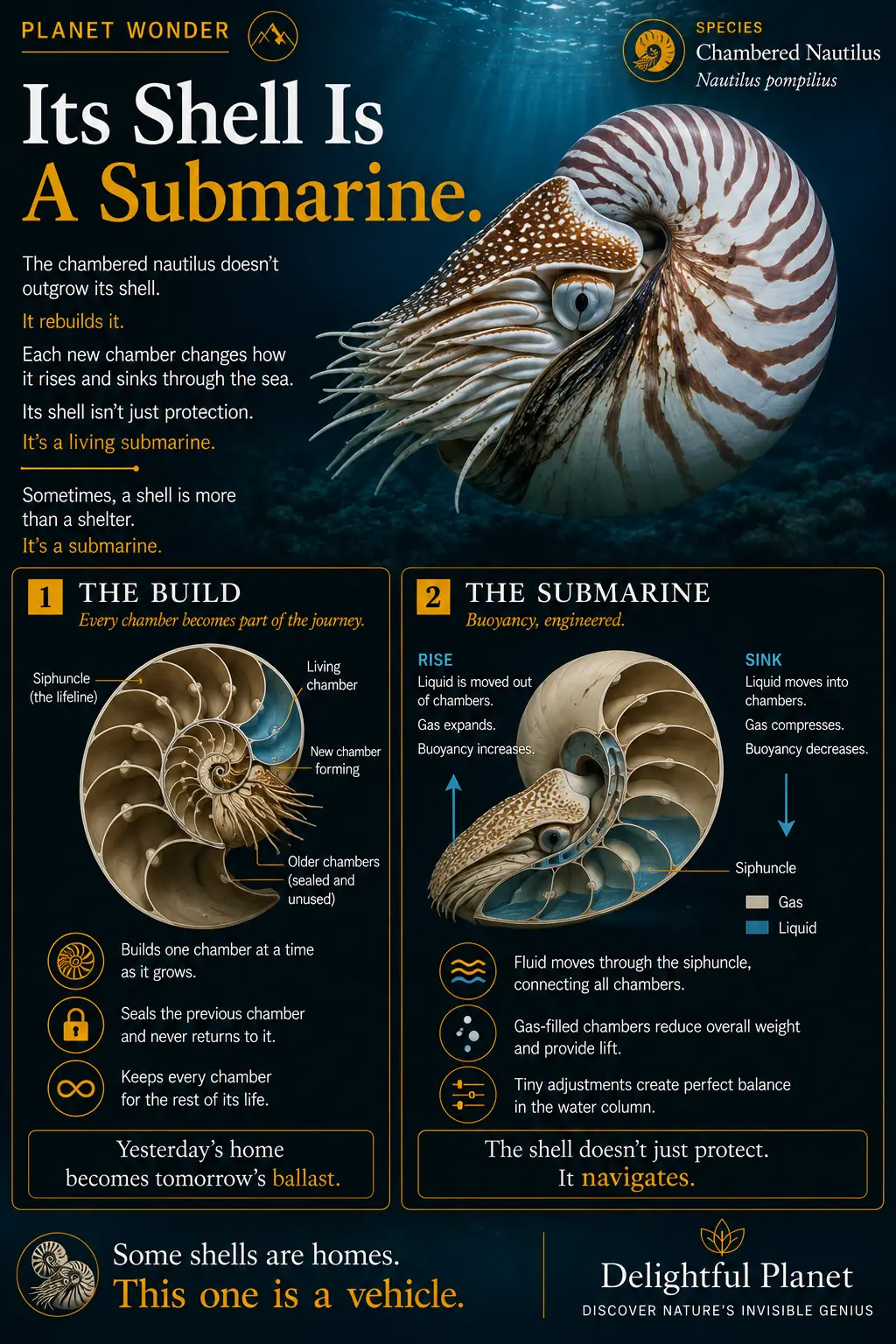
The chambered nautilus builds its shell one chamber at a time. Each new chamber is sealed off as the animal moves forward into a larger one — and each sealed chamber becomes part of a buoyancy control system of extraordinary precision, allowing the nautilus to hover at any depth, ascend or descend with minimal energy expenditure, and navigate a vertical range spanning hundreds of meters. The shell is not just armor. It is a vehicle.
The mechanismThe key is a thin tube of living tissue called the siphuncle, which threads through a small opening in each septum, connecting every sealed chamber to the animal's body. To rise, the nautilus pumps ions — primarily sodium and chloride — out of the fluid inside a chamber through the siphuncular epithelium. This creates an osmotic gradient that draws the fluid itself out of the chamber and into the bloodstream. As the chamber empties, gases dissolved in the animal's blood — primarily nitrogen, with some oxygen and carbon dioxide — diffuse inward to fill the space. The chamber is now gas-filled, lighter than water, and the animal becomes more buoyant. To descend, the process reverses: ions are pumped back into the chamber fluid, water flows in under osmosis, gas diffuses out, and the overall density of the shell increases.
The process is slow — the maximum ascent or descent rate is approximately three meters per minute — but it is extraordinarily energy-efficient. Once neutral buoyancy is achieved, the nautilus expends almost no energy to maintain it. The shell holds the balance passively while the animal rests, feeds, or moves horizontally using jet propulsion. The chambered architecture that looks like decoration is a finely tuned hydrostatic apparatus.
The nautilus typically inhabits depths of 100 to 500 meters on Indo-Pacific reef slopes, making nightly upward migrations to shallower water to feed on crustaceans and carrion, then descending again during the day. Worth being precise here: there is a depth limit to the buoyancy system. Below approximately 240–250 meters, hydrostatic pressure exceeds the osmotic pressure the siphuncle can generate, meaning the nautilus cannot empty its chambers and loses the ability to achieve positive buoyancy. Any dive below that threshold requires a recovery period at shallower depth to re-equilibrate. The nautilus operates in a pressure envelope defined by the physics of its own shell.
The only surviving externally shelled cephalopod
The nautilus lineage extends back to the Palaeozoic — it is the sole surviving externally shelled cephalopod from an era that produced hundreds of genera, most famously the ammonites. It is commonly described as a "living fossil," a term that captures its morphological conservatism — the chambered shell and pinhole eye have persisted largely unchanged across an enormous span of geological time. The label is contested in the scientific literature, since genetic analysis shows the lineage is not entirely static, but the nautilus's persistence of ancestral form while its relatives were replaced or transformed makes it genuinely unusual.
The genome of *Nautilus pompilius* was published in 2021, revealing a compact, minimalist genome with slow evolutionary rates — among the slowest measured in any known cephalopod. The genome confirmed the conserved biomineralization toolkit responsible for the shell's construction, and provided new insight into the pinhole eye: a camera-type eye without a lens, which trades acuity for function across the wide pressure and light range the nautilus inhabits.
The nautilus solved, in living tissue, the same engineering problem that human submarine designers addressed in steel and ballast tanks — and solved it more elegantly, at a fraction of the mass, with no mechanical parts, no power source beyond the animal's own metabolism, and a precision that a depth gauge cannot match. Once neutral buoyancy is achieved, the siphuncle maintains it passively — the animal holds position at depth without effort while the shell does the work.
Some shells are homes. This one is a vehicle. And it has been navigating these waters for hundreds of millions of years.
Some shells are homes. This one is a submarine.