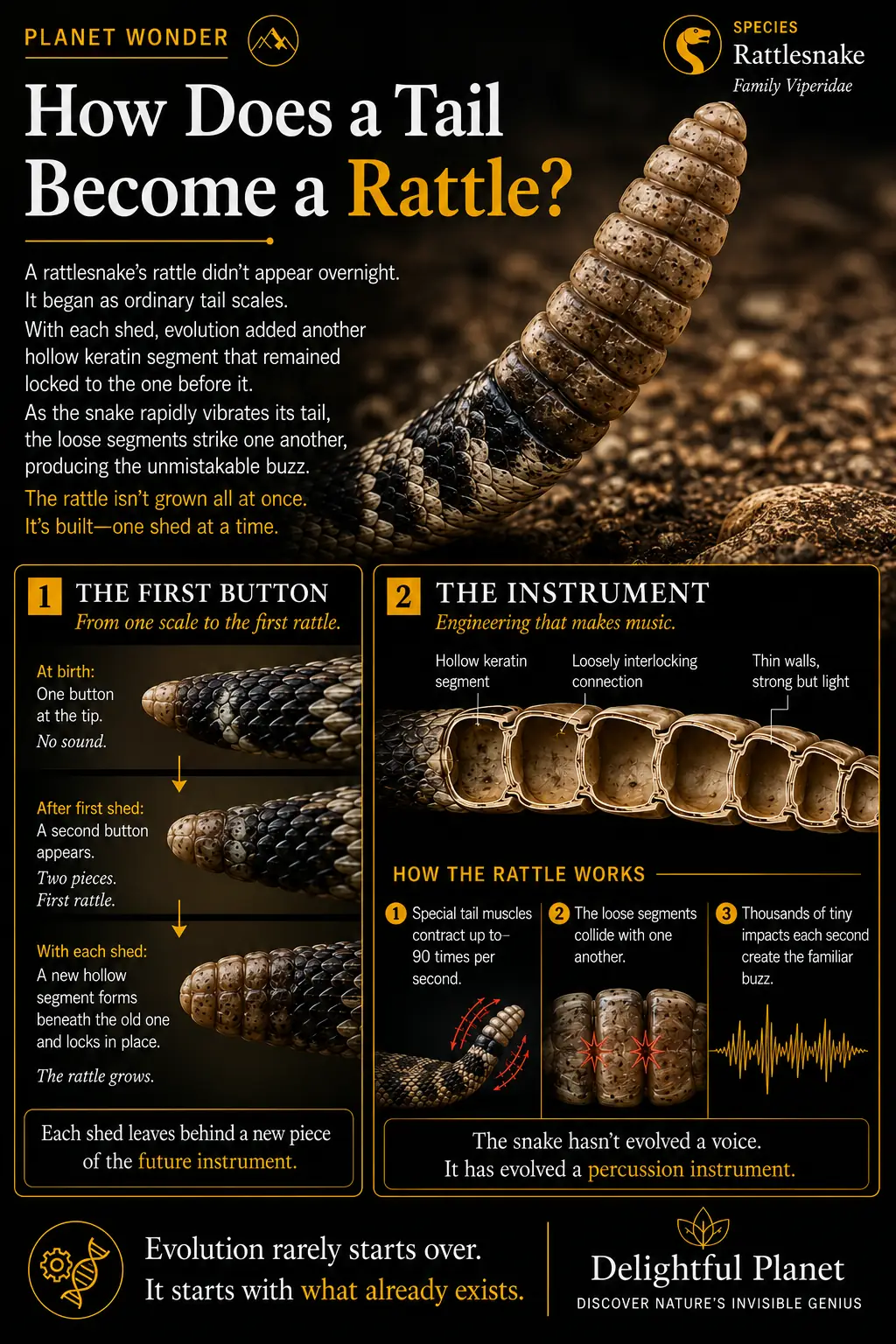
A newborn rattlesnake has a single rounded segment at the tip of its tail — called a button — and it makes no sound at all. There is nothing for it to strike against. The rattle it will eventually carry must be built, one shed at a time, over the course of its life. Each time the snake sheds its skin, a new hollow keratin segment forms at the base of the tail and locks onto the one before it. The rattle grows. The instrument assembles itself.
The mechanismEach segment is a hollow shell of keratin — the same protein as fingernails — with thin walls and a loosely interlocking connection to the adjacent pieces. The segments are not fused. They nest against each other with just enough slack that when the tail moves, they clatter. When the snake vibrates its tail, specialized muscles at the tail's base contract and relax in rapid alternation — up to 90 times per second in some species, among the fastest sustained muscle contractions of any vertebrate. Each contraction drives the segments into each other, producing a brief impact. At 90 cycles per second, thousands of these impacts merge into the continuous buzzing sound that carries the warning.
The tailshaker muscles that power this are physiologically unusual. Research published in the Journal of Experimental Biology confirms they can sustain contraction at up to 90 Hz for hours without fatiguing — an endurance performance that most vertebrate muscles cannot approach. They achieve this through an unusually high density of mitochondria, which supply the continuous ATP demand, and an equally high density of sarcoplasmic reticulum, which enables the rapid calcium cycling that drives each contraction. The muscle is built not for force but for speed and endurance simultaneously.
The rattle is not a fixed length. Segments accumulate with each shed — typically two to four times per year — but they also break off at the tip as the rattle ages and wears. A long rattle does not reliably indicate an old snake. What the rattle does indicate is the animal's investment in a warning system that costs venom to replace if ignored. Rattling is energetically cheaper than striking, and striking risks injury. A snake that successfully warns off a threat without striking has conserved both venom and safety. The rattle is, in this sense, a negotiating tool.
The rattle didn't start as a rattle
Tail vibration is a behavior shared across many snake species — including non-venomous ones — that predates the physical rattle by a wide margin. When a bull snake or corn snake vibrates its tail against dry leaves, it produces a faint rustling that loosely mimics a rattle. The rattlesnake's hollow keratin segments evolved on top of a behavior that already existed, amplifying and sharpening a warning signal that was already functional. Evolution rarely starts over. It starts with what already exists — and in this case, it took a tail-vibrating behavior and built an instrument around it.
A 2021 paper in Current Biology added a further twist: as a threat approaches, rattlesnakes abruptly shift from a lower rattling frequency to a higher one, creating an acoustic illusion that makes the snake sound closer than it actually is. The rattle is not just a warning. It is a perception-altering signal — one that has been refined to manipulate the distance judgment of whatever is approaching.
The rattle is an example of exaptation — a structure that was co-opted from one function and elaborated into another. The tail scale that became the first button was not selected for sound production. It was selected because it stayed attached after shedding, and because that retained segment, once a second one formed behind it, happened to produce a noise. That noise turned out to be useful. Evolution did not design the rattle from scratch. It found a path through what was already there.
Evolution rarely starts over. It starts with what already exists — and what it built here, from a single retained scale, is one of the most recognized warning signals in the natural world.
The rattle isn't grown all at once. It's built — one shed at a time.