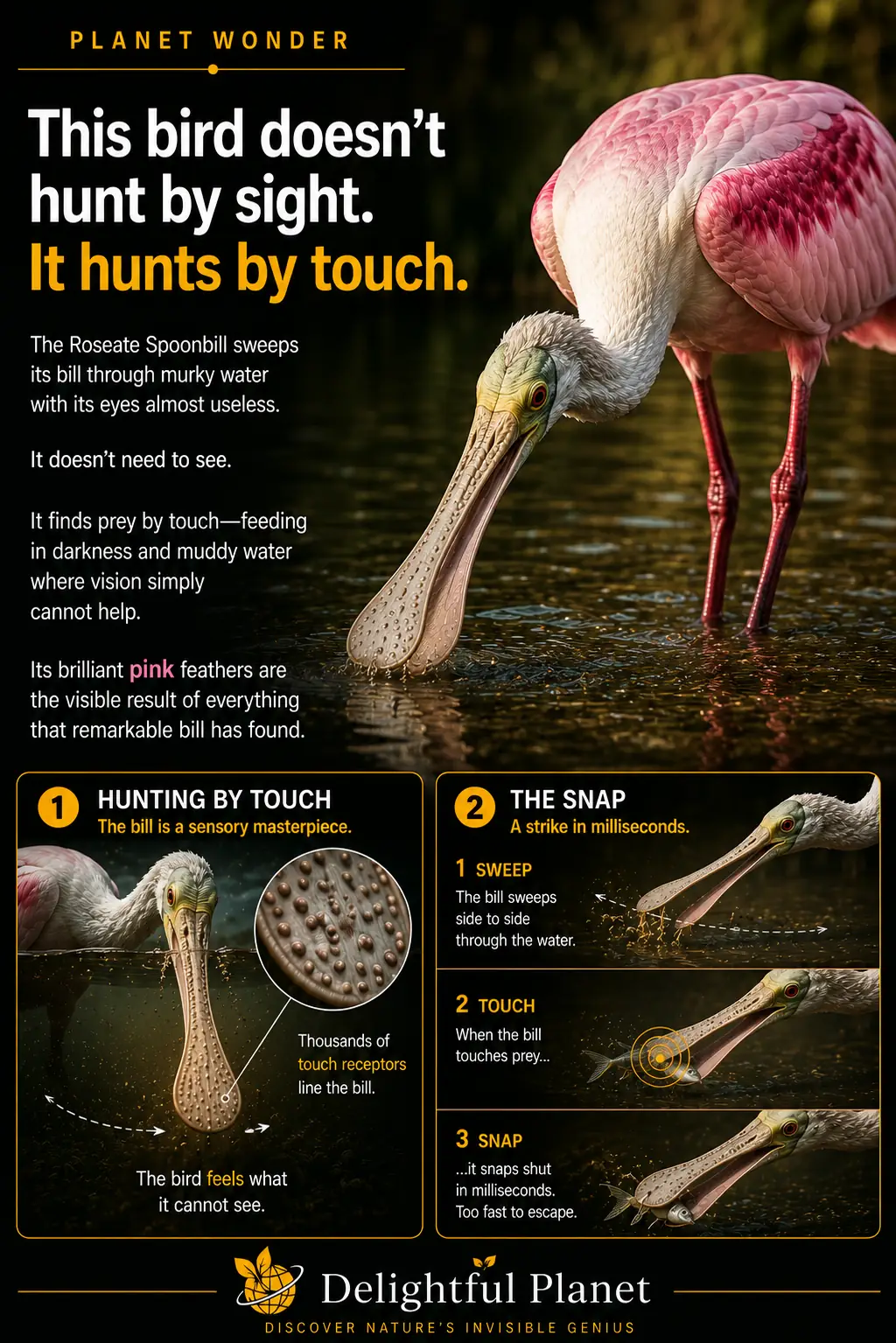
In the shallow tidal flats and murky wetlands of the Americas, the Roseate Spoonbill wades forward with its bill submerged and swinging — side to side, side to side — through water its eyes cannot read. It is not searching. It is listening, with its face, for the faintest disturbance in the water around it. When something registers, the bill has already snapped shut.
The mechanismThe spoon shape is not aesthetic and it is not accidental. The flattened, widened tip of the bill maximizes the surface area in contact with the water column as the bird sweeps — covering more ground per stroke than any narrower bill could. But the shape is only the beginning. Embedded within the bone of the bill tip are thousands of small pits, each housing clusters of mechanoreceptors — Herbst corpuscles — the same type of pressure-sensitive nerve endings found in the bills of kiwis and sandpipers. In spoonbills, these pits number in the tens of thousands, far more than in most other tactile-foraging birds.
What these receptors detect goes beyond simple contact. Research on related species has shown that bill-tip organs of this kind can sense the pressure waves and vibrations that moving prey create in the surrounding water — a capacity called remote touch. The bird does not need to physically strike a shrimp. It may detect the shrimp's movement before contact is made. When the signal registers — whether from direct touch or from the pressure field of something nearby — a reflex snaps the bill closed. The prey is caught before it has time to flee.
The Roseate Spoonbill forages in conditions that defeat every visual predator: water stained brown by tannins, shallows roiled by wind, feeding at dusk and dawn when light is low. In these environments, sight is not just difficult — it is the wrong tool entirely. The spoonbill's bill solves the problem by replacing the eye with touch, and by making touch fast enough to catch something that would escape if the bird had to think about it. The snap is a reflex, not a decision. The water column is the hunting ground, and the bill reads it the way a hand reads a surface in the dark.
The pink is the bill's receipt
The Roseate Spoonbill's extraordinary color is entirely diet-derived. The carotenoid pigment canthaxanthin — found in the shrimp, crustaceans, and aquatic invertebrates the bird catches — is absorbed during digestion and deposited into the feathers during molting. A bird with access to abundant prey glows deep rose and carmine. A bird on a poor diet grows pale pink, nearly white. The plumage is a running record of what the bill has found.
Juvenile spoonbills hatch with straight bills. The characteristic spoon shape develops gradually over the first weeks of life, fully formed by around six weeks. The sensory pits develop alongside it — the instrument and its sensors built together from the start.
The remote-touch bill-tip organ evolved independently in at least three unrelated lineages: shorebirds such as sandpipers and snipes, kiwis, and the ibis family — which includes spoonbills. These groups share no recent common ancestor. Each arrived at the same solution — a dense array of mechanoreceptors housed in bony pits at the bill tip — by encountering the same ecological problem: finding hidden or submerged prey in opaque substrates where vision gives no information. The spoonbill's version is among the most elaborately developed of any known species, with sensory pit counts far exceeding those of other tactile foragers.
Engineers designing underwater sensors face an analogous challenge: detecting objects in turbid water where sonar is too coarse and cameras are blind. The spoonbill's bill offers a different model — not a single powerful sensor but a distributed array of thousands of sensitive receptors, each reading a tiny patch of the pressure field, the aggregate resolving into a coherent picture of what is moving nearby. The bird does not see its prey. It reads the water the prey is moving through.
Cornell Lab describes the Roseate Spoonbill as feeding in water typically less than five inches deep. In that shallow band — too murky for eyes, too confined for sonar — the bill sweeps its arc and the sensors report. Every pink feather on the bird's body is evidence that the system works.
This bird doesn't hunt by sight. It hunts by touch. And it has been reading the water this way, in the wetlands of the Americas, since long before we learned to name the colors it wears.