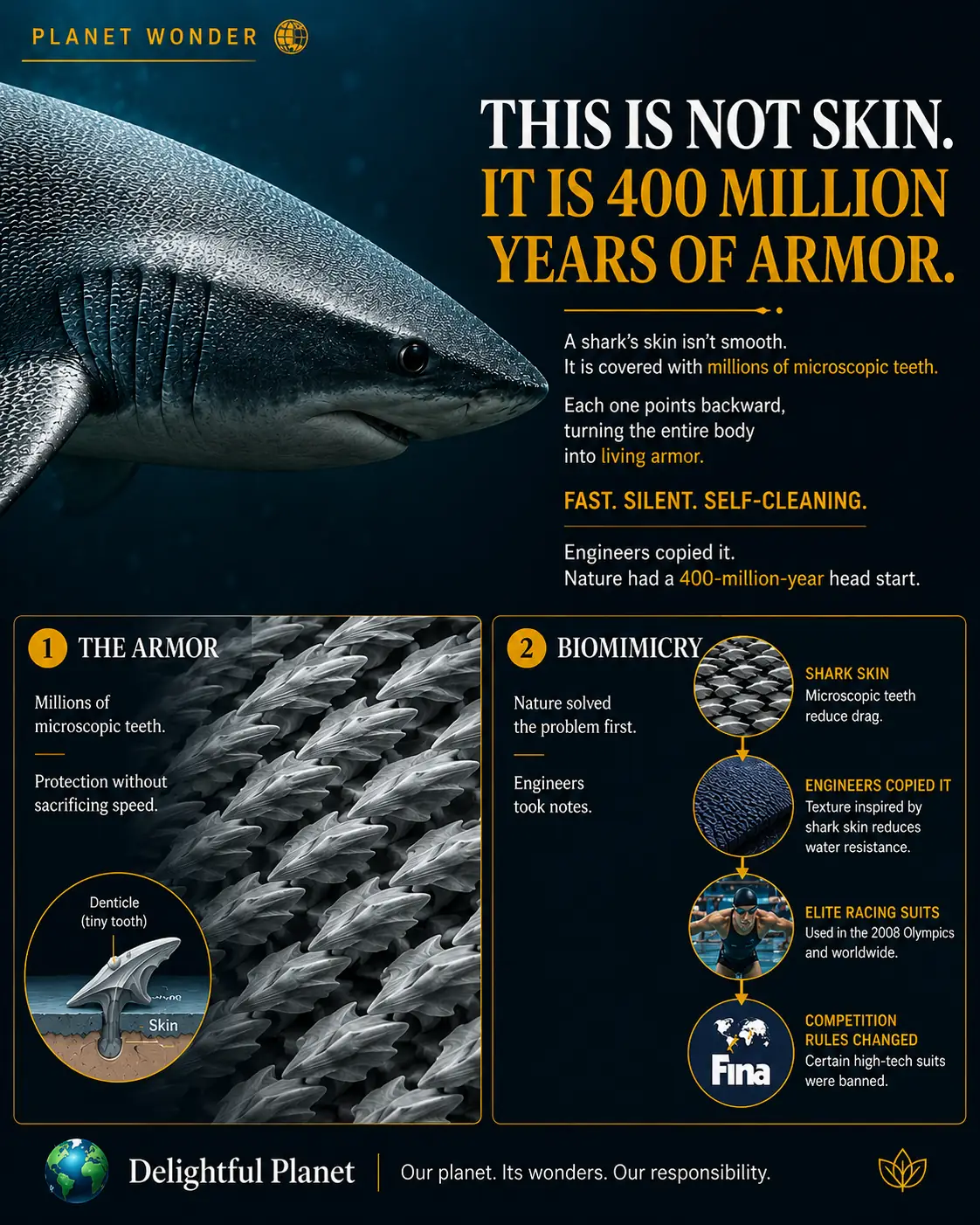
Run your hand along a shark from head to tail and it feels smooth. Run it the other way and it draws blood. What you are touching is not skin in the way we usually mean it — it is a body covered in millions of microscopic teeth, each one anchored in the skin, each one pointing backward, each one a tiny piece of the same material that lines the shark's mouth. The surface that looks like skin is, in fact, a suit of living armor that the shark grows, renews, and has been refining for longer than trees have existed on land.
The mechanismEach individual structure is called a dermal denticle — from the Latin for "skin tooth" — and the name is precise. Denticles are structurally identical to teeth: a hard outer layer of enamel-like material, a layer of dentine beneath it, and a pulp cavity at the core connected to the skin by a base plate. They are not scales in the way fish scales are scales. They are teeth that cover the entire body. Unlike oral teeth, which sharks replace continuously throughout their lives, denticles do not undergo the same autonomous renewal — though shed denticles can be replaced, and new ones grow to cover expanding body surface as the shark grows.
The arrangement of denticles varies across the body and across species, but in fast-swimming sharks — the mako, the great white, the blue shark — the denticles on the flanks carry fine parallel ridges along their crowns. These ridges, called riblets, run in the direction of water flow. As water moves over the surface, the riblets disrupt the formation of turbulent vortices in the boundary layer — the thin film of water closest to the skin — reducing the friction drag that would otherwise slow the shark down. The denticles also have an anti-fouling function: their texture and the mucus the shark produces prevent bacteria, algae, and other organisms from establishing on the surface, keeping the skin clean without any active effort from the shark.
Worth being precise here: the drag reduction effect of dermal denticles is real but genuinely contested in the scientific literature. Some peer-reviewed studies report skin friction drag reductions of up to 10% from denticle riblets; others find that three-dimensional denticle geometry can actually increase drag compared to a smooth flat plate under certain flow conditions. The mechanism operates differently depending on the flow regime, the denticle shape, and the part of the body being measured. What is not in dispute is that fast-swimming sharks have converged on denticle geometries that enhance their hydrodynamic performance — and that those geometries have been refined across hundreds of millions of years of evolutionary pressure. Nature's testing regime is thorough.
The swimsuit that had to be banned
In 2008, Speedo introduced the LZR Racer — a competition swimsuit developed in collaboration with NASA and inspired, in part, by shark skin denticles. The suit incorporated surface panels designed to mimic the drag-reducing properties of denticle riblets, alongside polyurethane panels that compressed the swimmer's body and provided buoyancy. At the 2008 Beijing Olympics, 25 world swimming records were broken. Twenty-three of them were set by swimmers wearing the LZR.
The performance advantage was so dramatic that FINA — the international governing body of swimming — banned the suit in 2009, describing the technology as a form of "technological doping" that compromised the integrity of the sport. The new rules, in effect from 2010, restricted suits to textile-only materials, banned buoyancy aids and compression beyond defined limits, and prohibited full-body coverage. The shark's surface had been translated into a competitive advantage precise enough to threaten the sport's record books — and the sport responded by changing the rules.
The denticle is older than almost anything we can easily picture. The peer-reviewed literature traces odontodes — the ancestral tooth-like structures from which dermal denticles descend — back more than 450 million years. Sharks themselves, as a lineage, appear in the fossil record around 400 million years ago, with the earliest known intact shark fossil, Doliodus problematicus, dating to the Early Devonian. The poster's title — "400 million years of armor" — captures the shark lineage accurately; the underlying tooth-skin technology is older still.
In that span of time, the basic design has not been abandoned. It has been varied — denticle shape differs across species, across body regions, across life stages — but the core structure remains: a mineralized tooth anchored in skin, oriented to manage the flow of water over the body. Every modification is a variation on the same solution. The shark did not invent a new answer every few million years. It found one answer and has been refining it ever since.
The applications being explored today go well beyond swimsuits. Researchers are developing denticle-inspired surfaces for ship hulls, aircraft fuselages, wind turbine blades, and medical implants — anywhere that drag, biofouling, or surface friction is a problem. NASA studied the riblet geometry for aircraft skin. The engineering challenge is to replicate not just the shape but the flexibility — denticles can bristle, changing their angle relative to the flow as the shark maneuvers. A static copy is a partial copy. The full system is still ahead of us.
This is not skin. It is 400 million years of armor — and engineers are still learning to read it.