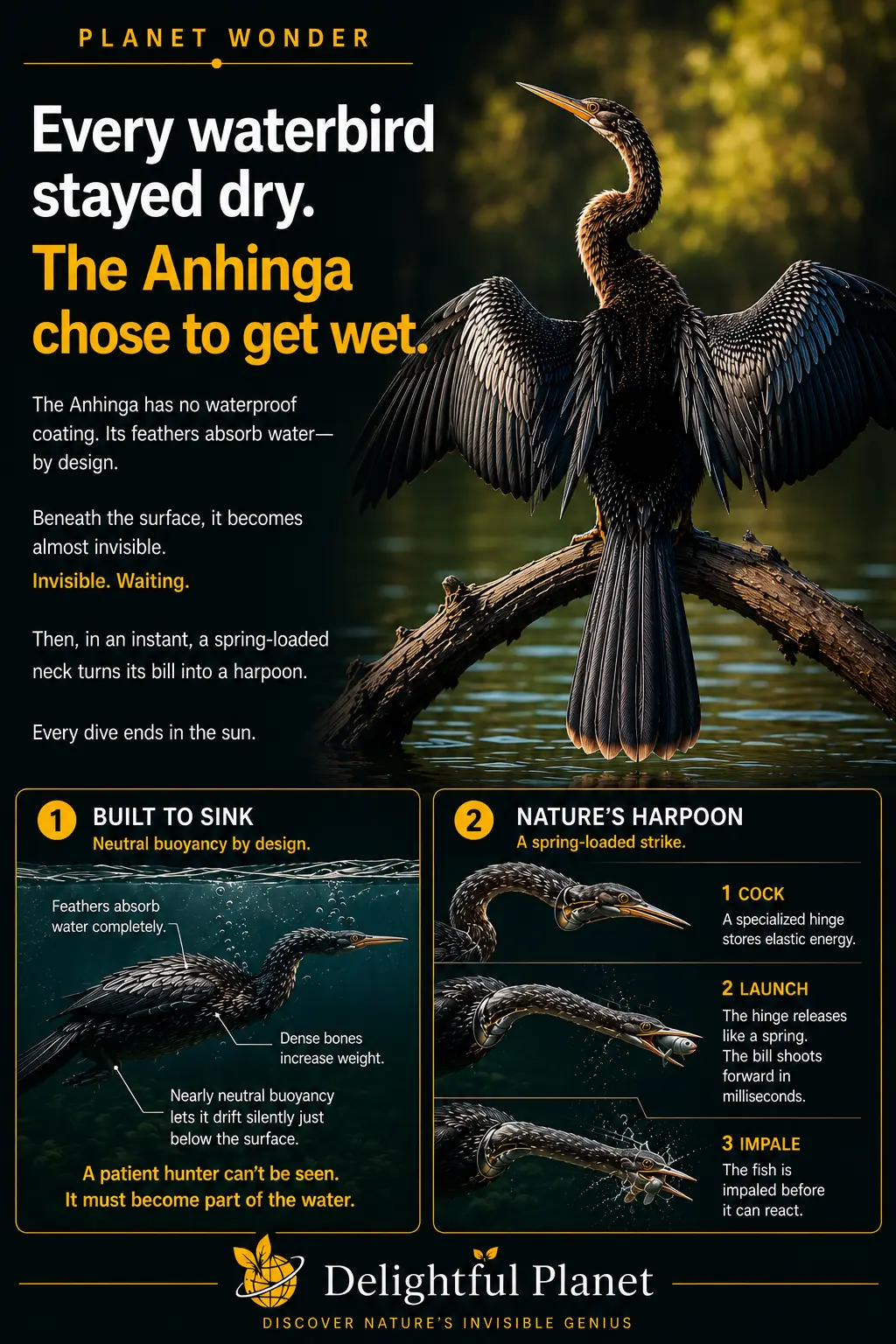
Every waterbird solved the same problem the same way: keep the feathers dry. Oils from the uropygial gland, applied during preening, coat the plumage and trap air, so the bird floats high and warm. The Anhinga looked at the same problem and arrived at a completely different answer. It stopped waterproofing its feathers. It let them soak. And in doing so, it became something no buoyant bird can be — nearly invisible beneath the surface, drifting without effort, waiting.
The mechanismMost waterbirds have feathers with interlocking barbules that trap air and repel water. The Anhinga's body feathers lack this microstructure. They absorb water completely on submersion. Combined with bones that are denser than those of most birds — less pneumatic, less air-filled — the result is near-neutral buoyancy: the bird neither sinks nor floats but hangs suspended just below the surface, moving through the water with minimal effort and minimal disturbance. A patient hunter drifting through submerged vegetation is one a fish cannot see coming.
The second mechanism is the strike. The Anhinga's neck is held in a pronounced S-curve when the bird is stalking underwater — a kinked position that stores potential energy in the loaded muscles and tendons of the neck. Between the eighth and ninth cervical vertebrae sits a specialized hinge joint that functions as a trigger: when the Anhinga strikes, this joint releases, and the S-curve straightens explosively, launching the bill forward in an instant. The fish is impaled before it has time to react. The bird then surfaces, tosses the fish into the air, and catches it head-first to swallow.
The trade is precise and total. Wettable feathers grant stealth and neutral buoyancy at the cost of waterproofing and insulation. Once wet, the Anhinga loses body heat rapidly — water conducts heat away from the body far faster than air — and it cannot fly until the feathers dry. Every dive ends the same way: the bird surfaces, climbs to a perch, spreads its wings in the sun, and waits. The iconic spread-winged posture is not display. It is necessity. The Anhinga has traded the autonomy of a dry bird for the hunting advantage of a wet one, and the sun is the price it pays every time.
The cormorant solved the same problem differently
The Double-crested Cormorant is often seen alongside the Anhinga in the same wetlands, spreading its wings in a nearly identical posture. It too has partially wettable plumage and dense bones. But research published in 2024 found that the two birds handle the oxygen demands of diving very differently: cormorants store most of their oxygen in large, well-oxygenated leg muscles suited to aggressive swimming, while anhingas rely more on neutral buoyancy and a slower, stalking approach — drifting rather than chasing, conserving rather than powering.
Two birds, the same wetland, the same wet-feather strategy, the same wing-spreading posture — and completely different hunting physics underneath.
The Anhinga is sometimes called the snakebird — a name that becomes obvious the moment it surfaces. Swimming with its body submerged, only the sinuous neck and head visible above water, it looks less like a bird than like something that has no business being in a wetland at all. The name is apt in another sense: like a snake, the Anhinga is an ambush predator, and the S-curve of the neck it holds before a strike is structurally similar to the coiled posture a striking snake maintains. The energy is stored in the geometry of the curve, released through the straightening.
The engineering lesson is the same one the Anhinga has been running for millions of years: the most effective solution to a problem is not always the most obvious one. Every other waterbird optimized for staying dry. The Anhinga optimized for what being wet enables. The feathers are not a liability. They are the design. The sun-spread at the end of every dive is not a failure of waterproofing. It is the operating cost of a different and more effective strategy — paid, without complaint, in full, every day.
Every waterbird stayed dry. The Anhinga chose to get wet. And it has been hunting this way, in the warmest wetlands on Earth, for longer than the wetlands themselves have had their current names.