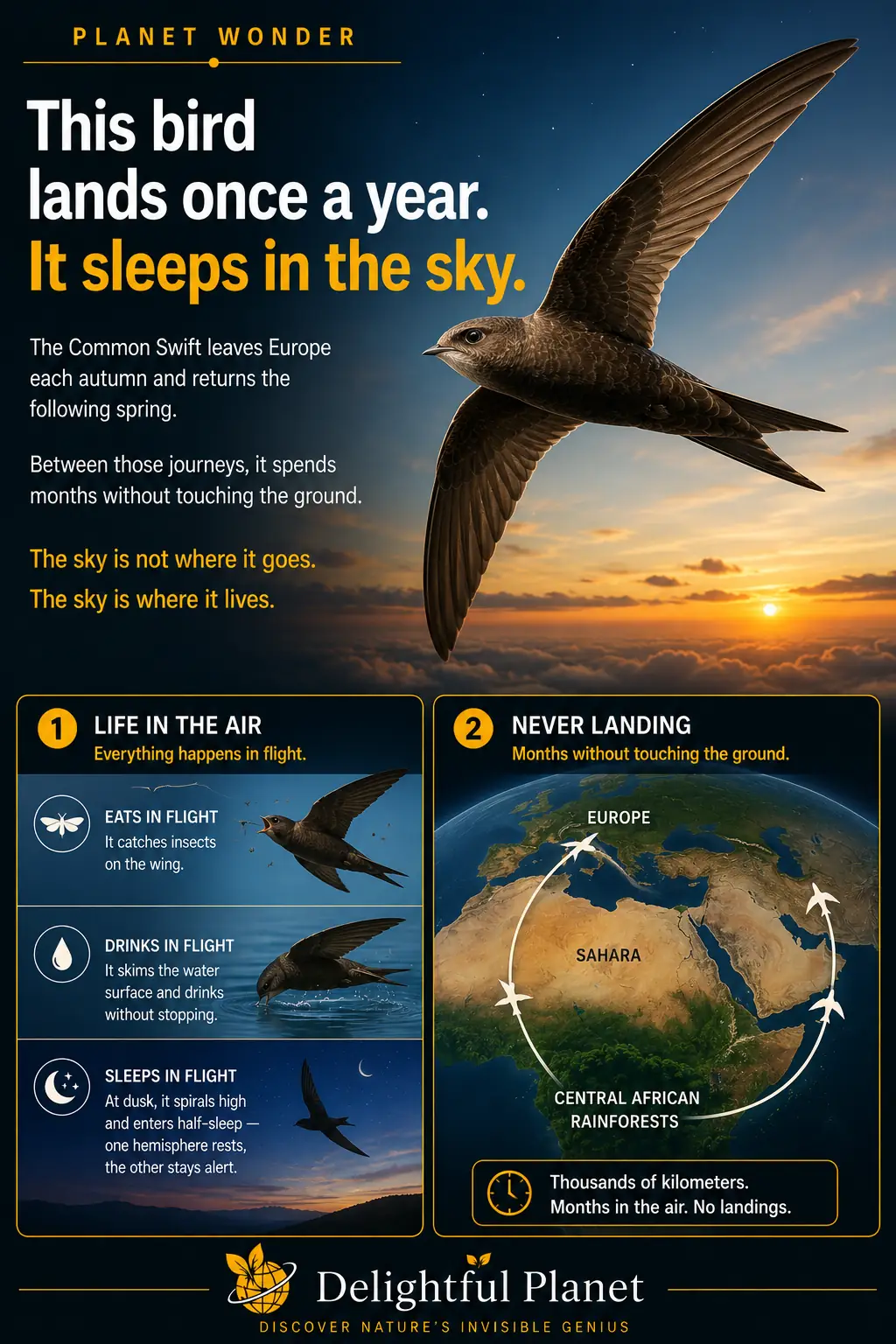
Every August, the Common Swift leaves its nest in a European building and climbs into the sky. It will not touch the ground again until it returns the following spring. In the ten months between those two moments, it will eat, drink, and sleep entirely in the air — crossing continents, riding thermals, feeding on insects it catches on the wing — living a life that requires no surface at all.
The mechanismThe evidence comes from a 2016 study published in Current Biology by Lund University ornithologists, who attached micro data-loggers with accelerometers to Common Swifts and tracked their activity through the non-breeding season. The data showed that swifts remain airborne for more than 99% of their ten-month non-breeding period. Three of the thirteen tracked birds never landed once in the entire ten months. Those that did land stopped for no more than one or two hours at a time, and still spent more than 99.5% of the period in the air. Roost sites for Common Swifts have never been found in sub-Saharan Africa. The sky is not where the bird goes. It is where the bird lives.
Eating in flight is straightforward for a swift — it catches insects on the wing, mouth open, skimming through clouds of aerial plankton. Drinking happens at speed, the bird dropping to skim a water surface and scooping as it passes. Mating primarily occurs at the nest, though aerial copulation has been documented. Nest material is gathered in flight. The swift's legs are so reduced that landing on a flat surface leaves it stranded — it cannot generate the lift to take off again without dropping from a height. Every aspect of the bird's body is optimized for air, and the ground is a hazard.
The ten-month airborne record is the longest confirmed for any bird species. The Lund University team described the discovery as significantly pushing the boundaries of what is known about animal physiology. A bird sustaining continuous flight for this duration must manage energy, hydration, muscle maintenance, and sleep — all without access to the resources a perched or grounded bird takes for granted. That it does so, across two continents and thousands of kilometres of migration, is the physiological puzzle the swift quietly solved long before we had instruments small enough to detect it.
The sleep question — and what the data suggests
The most counterintuitive part of the swift's aerial life is sleep. Every animal that has been studied needs it. A bird airborne for ten months must sleep somewhere — and the only available surface is air. Twice each day, at dawn and dusk, the Lund University data showed sudden spikes in flapping activity followed by extended gliding. The birds appear to climb to altitude at twilight and then glide slowly down through the night — a behavior consistent with sleep on the wing.
Worth being precise here: direct EEG evidence for sleep in flight has been confirmed in great frigatebirds — showing both unihemispheric sleep, where one hemisphere rests while the other remains active, and bihemispheric sleep. For Common Swifts, the evidence remains behavioral and circumstantial. Wikipedia's entry on unihemispheric sleep notes that "evidence for USWS is strictly circumstantial" in swifts. The twilight ascent pattern is consistent with aerial sleep, but the neurophysiology has not been directly measured. The swift almost certainly sleeps in the air. How exactly it does so remains an open question.
A Common Swift can live to twenty years — the oldest recorded individual reached 21. A bird that lives that long will have spent roughly sixteen of those years in continuous flight. One calculation cited by the Lund University team puts the total distance flown by a long-lived individual at more than enough to reach the moon and back seven times. The bird accumulates this distance not through any single extraordinary feat but through the ordinary operation of a body that treats the air as its native habitat and the ground as the exception.
The physiological questions this raises have not been fully resolved. How does a bird maintain muscle mass during ten months of continuous use without the recovery that rest normally provides? How does it regulate hydration without access to still water? How does it process sleep in a way that is compatible with sustained flight? Each of these is an open research question. The swift's biology is several chapters ahead of the science that is trying to read it.
Engineers working on long-duration unmanned aerial vehicles — drones designed to stay aloft for weeks or months — face the same constraints the swift has already solved: energy efficiency, structural endurance, and the management of all necessary functions without landing. A bird weighing 40 to 50 grams and crossing the Sahara twice a year is, in this sense, the design brief the field is working toward.
This bird lands once a year. The rest of the time, it lives in the sky — and has done so, without interruption, for longer than we have had words for what it is doing.