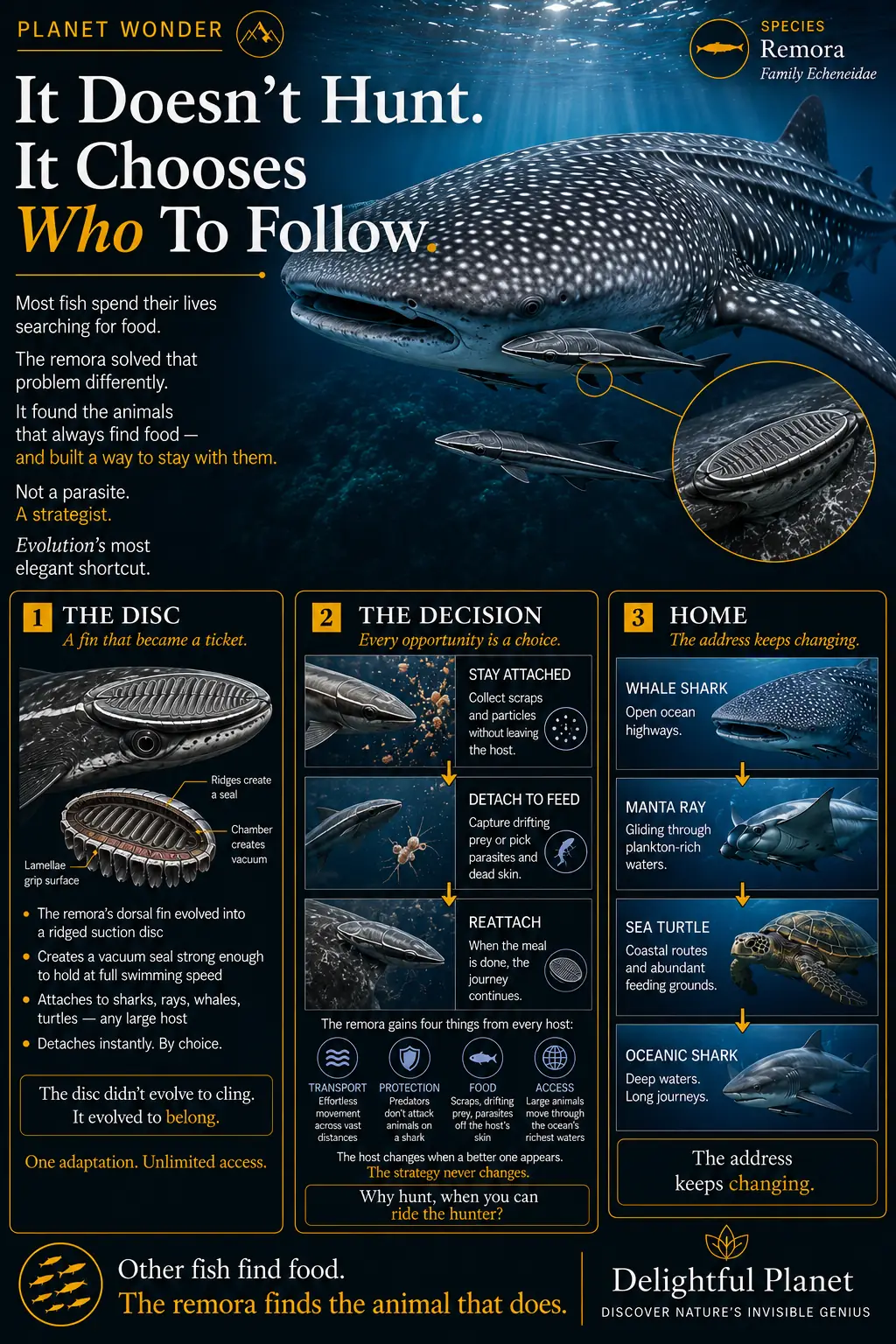
Most fish spend their lives searching for food. The remora solved that problem differently. Instead of hunting, it found the animals that always find food — sharks, manta rays, whale sharks, sea turtles — and built a biological mechanism to stay with them. One adaptation. Unlimited access to the ocean's most productive hunters and travelers. The remora doesn't compete for food. It outsources the problem entirely.
The mechanismThe disc on top of a remora's head is not a suction cup in any simple sense. It is a highly modified dorsal fin — confirmed by Britz and Johnson in a 2012 paper in the Journal of Morphology, which tracked the disc's development from larval stages and proved definitively that it is homologous to the spiny dorsal fin of other fish, radically restructured over roughly 32 million years of evolution. The interior of the disc is lined with rows of flat, plate-like structures called lamellae, each covered in rows of tiny tooth-like projections called spinules. When the remora presses the disc against a host, the outer fleshy lip creates a seal, and the lamellae rotate upward — their spinules gripping microscopic surface features of the host's skin. The result is a combined suction and friction hold strong enough to maintain attachment at full swimming speed. To release, the remora swims slightly forward. The lamellae fold flat. Detachment is instantaneous.
The disc requires no energy to maintain once attached. The remora gains transport, protection from predators that avoid attacking animals on a shark, access to food scraps and particles, and passage through ocean waters it could not efficiently cross alone. It can detach to feed independently — picking off parasites, capturing drifting prey — and reattach to the same or a different host when done.
Worth being precise here: the remora relationship is often described as commensal — the remora benefits, the host is unaffected. A 2024 review in the Journal of Fish Biology by Gayford found that this framing is too simple. The relationship slides along a spectrum from mutualism to parasitism depending on context. Remoras do consume parasites from host skin, which may benefit the host. But multiple remoras attached simultaneously create measurable hydrodynamic drag — an energy cost the host pays. Sharks have been observed attempting to dislodge remoras. The net outcome for the host shifts with the number of remoras, the host's condition, and the circumstances. The remora is not cleanly a parasite, not cleanly a commensal. It is a strategist operating on a spectrum.
The disc as a design problem — solved
Engineers studying underwater adhesion have studied the remora disc extensively. The challenge it solves — attaching strongly to a curved, moving, biologically variable surface in high-flow conditions, releasing instantly on demand, at no metabolic cost during attachment — remains difficult to replicate artificially. A 2019 paper in Science Robotics built a biomimetic remora disc and demonstrated attachment forces comparable to the biological original on shark skin, smooth steel, and whale skin. The spinule geometry — tiny projections that dig in harder as shear force increases — is the key insight. The disc grips more tightly the faster the host swims.
The remora's strategy is a different answer to the same question every predator faces: how do you get enough energy to survive? Most solutions involve becoming a better hunter — faster, more perceptive, more precise. The remora's solution is to stop hunting and instead invest in access. The disc is not a weapon. It is a ticket. And the animal holding it gets to travel with the ocean's most effective hunters, feed in the richest waters, and move across distances no small fish could cover on its own — all without competing for a single meal.
The host changes when a better one appears. The strategy never does.
It doesn't hunt. It chooses who to follow. That's the whole strategy.