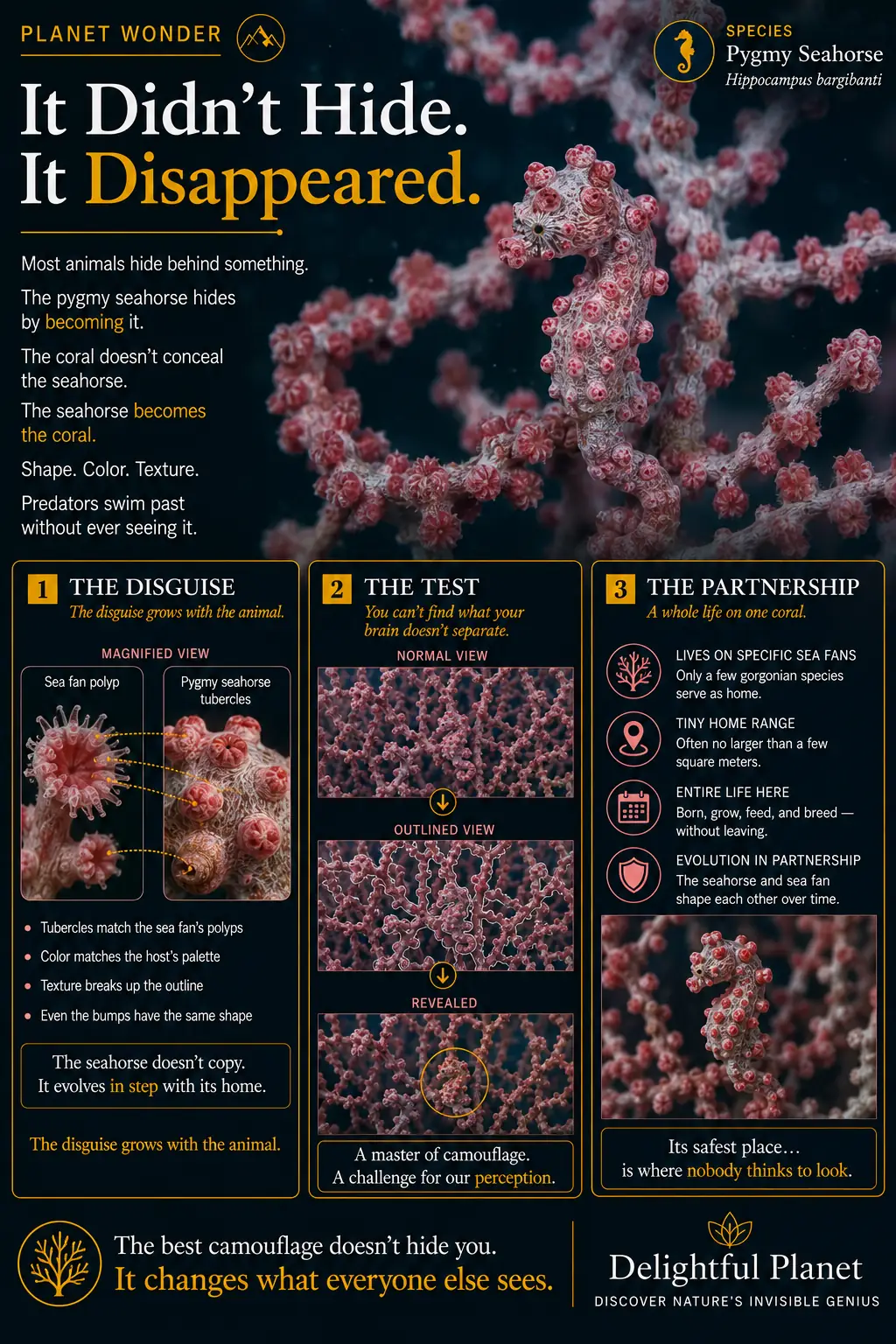
In 1969, a New Caledonian scientist named Georges Bargibant was collecting gorgonian sea fans for the Nouméa museum when he noticed something on his dissection table that should not have been there: a pair of tiny seahorses, less than two centimeters long, clinging to the coral he had just collected. They had been there the whole time. Nobody had seen them. The species had eluded science entirely — not because it was rare or deep or remote, but because it had perfected the art of not being seen at all.
The mechanismBargibant's pygmy seahorse (*Hippocampus bargibanti*) spends its entire life on gorgonian sea fans of the genus *Muricella*. It does not merely live there — it becomes them. The body is covered in large, rounded tubercles — bulbous skin protrusions — that precisely replicate the polyps of the host coral in shape and size. The color of the seahorse matches the coral's palette: gray or purple individuals with pink-red tubercles live exclusively on *Muricella plectana*; yellow individuals with orange tubercles live on *Muricella paraplectana*. The texture of the skin breaks up the outline of the body. The result is an animal that is effectively invisible at close range — not hidden behind the coral, but visually indistinguishable from it.
Worth being precise here: the color matching is not a flexible, adaptive response. It is fixed at settlement. When a juvenile pygmy seahorse settles onto a host gorgonian, it takes on that coral's color — and that color is permanent. The animal cannot change host or change color. The match is determined once, early in life, and held for life. This is not camouflage that adjusts to circumstances. It is a commitment.
The home range of a pygmy seahorse is typically a single gorgonian — a few square meters at most. Born there, it feeds there, reproduces there, and dies there, without leaving. The host is not just a hiding place. It is the entire world. Up to 28 individuals have been recorded on a single sea fan, typically found in pairs that cling to the branches with their prehensile tails. The male carries the young in a brood pouch, and breeding occurs year-round. Everything happens on the same few branches of coral.
Still being discovered — genome sequenced in 2025
Bargibant's pygmy seahorse was the first of its kind found — named formally in 1970. At least six additional pygmy seahorse species have been identified since 2000, several discovered only because divers noticed animals that did not quite match *H. bargibanti* and brought them to scientific attention. The camouflage that hid the first species from science continued to hide its relatives for decades.
In 2025, a team of Chinese and German researchers published the first complete genome sequence of *H. bargibanti* in PNAS. The genome is providing new insight into the molecular basis of the seahorse's remarkable body plan — the coronet, the prehensile tail, the trunk brooding, and the tubercle patterning that makes this level of camouflage possible in the first place.
Most camouflage is about pattern — disrupting an outline, matching a background, breaking up a recognizable shape. The pygmy seahorse's camouflage works differently. It replicates structure. The tubercles are not a pattern drawn on a body. They are three-dimensional protrusions that match the three-dimensional polyps of the coral — same shape, same size, same color, same spacing. At the scale of the animal, the difference between a seahorse and a coral polyp disappears entirely. The predator's visual system finds no edge to follow, no shape to resolve.
This has a measurable consequence: experienced divers with years of reef time routinely swim past pygmy seahorses without seeing them. The species is not rare — on the right gorgonians at the right depth, they can be found in pairs or small groups. They are simply invisible until the eye learns what to look for, and even then the image takes a moment to resolve. A seahorse two centimeters long, on a coral branch, at depth, is an object lesson in what perfect visual integration between an animal and its environment actually looks like.
The best camouflage doesn't hide you. It changes what everyone else sees.
And it took us until 1969 to notice.