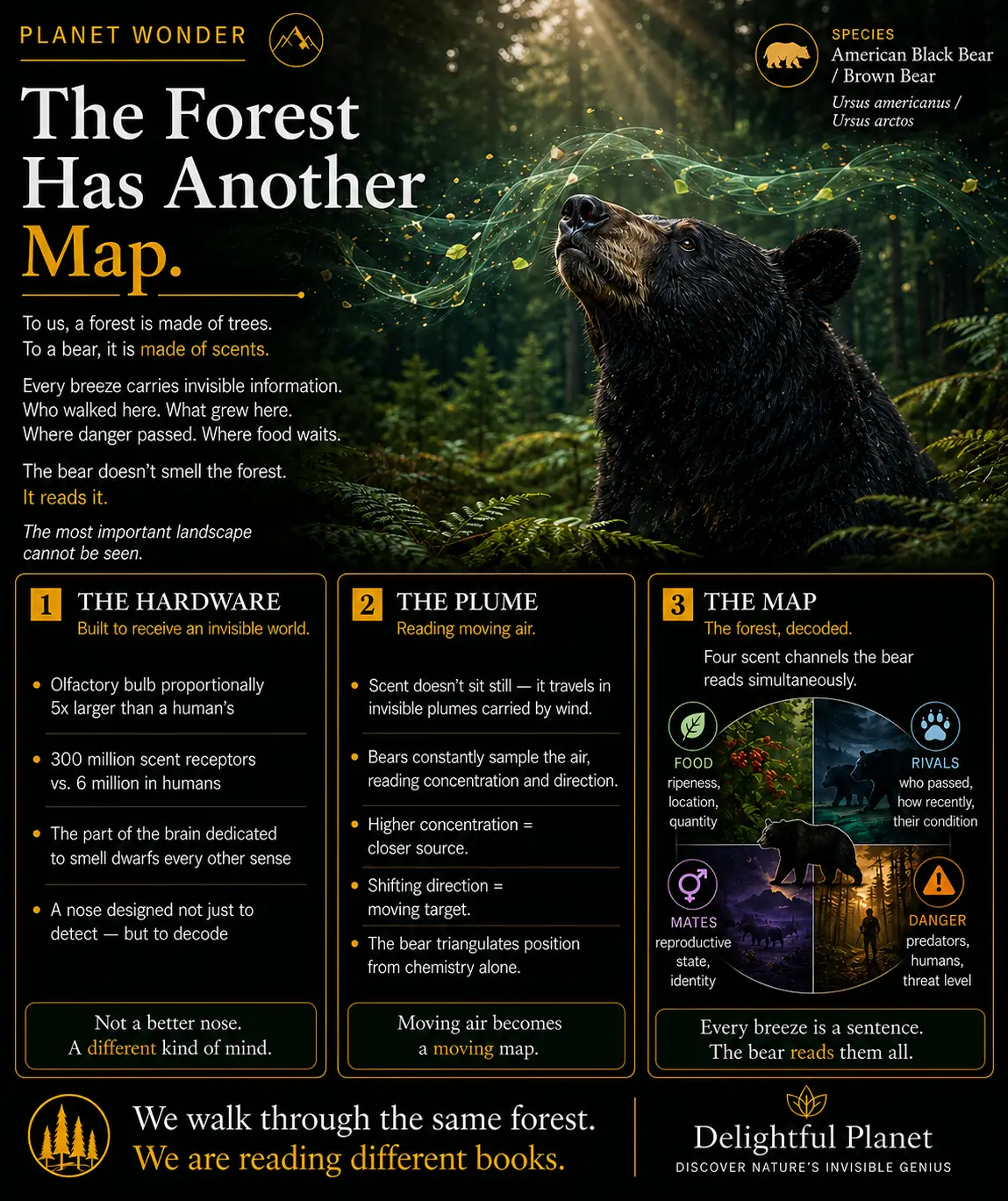
We walk through a forest and see trees. A bear moves through the same forest and reads it — a continuous stream of chemical information carried on the air, telling it what ripened overnight, who passed through this morning, whether a rival is nearby, and where something died. The forest the bear inhabits is not the forest we see. It is a landscape of scent, and the bear navigates it with hardware that makes our own olfactory system look rudimentary by comparison.
The mechanismThe hardware begins with the olfactory bulb — the region of the brain that processes scent. In a bear, this structure is at least five times larger than in a human, despite the bear's brain being only about one third the total size of ours. A disproportionate share of the bear's brain is devoted to interpreting chemical signals. The nasal cavity that feeds it is structured like a honeycomb — scroll-shaped bones called turbinates, coated in nasal mucosa and lined with millions of scent receptors, providing an enormous surface area to capture odor molecules from passing air.
Scent does not sit still. It travels as an invisible plume, carried by wind, dispersing and concentrating as it moves. A bear reads this plume actively — sampling the air continuously, tracking how concentration changes with direction. Higher concentration means a closer source. A shifting direction means a moving target. By comparing readings across time and position, a bear can triangulate the location of a food source, an animal, or a threat without ever seeing it. The nose is not just a detector. It is a navigation system.
The information the bear extracts from scent divides into four channels simultaneously. Food: ripeness, quantity, and location — a bear can detect a food source from kilometers away, and can assess its condition before arriving. Rivals: the scent trail of another bear carries identity, sex, size, and how recently it passed, allowing the bear to decide whether to follow, avoid, or investigate. Mates: reproductive state and identity, readable from scent marks left on trees and rocks across a large home range. Danger: predators, humans, and threat level — bears typically detect human presence by scent long before any visual or auditory signal reaches them.
Scent memory and the long game
Bear olfaction is inseparable from bear memory. Kim Annis, a Grizzly Bear Management Specialist with Montana Fish, Wildlife and Parks, describes bears returning to food sources they first encountered as cubs — a decade or more later — navigating directly to locations remembered through the association of scent and place. The olfactory map a bear builds over its lifetime is a detailed, durable record of where food appeared, when, and under what conditions. It is how a large omnivore manages a home range that can span hundreds of square kilometers.
The bear's olfactory system is a reminder that the sensory world we experience is not the only one available. We share a forest with an animal that is reading a completely different document — one written in chemistry, updated continuously by wind, and interpreted by a brain architecture tuned over millions of years to extract meaning from scent. What we call an undifferentiated smell, the bear parses into identity, location, time, and condition. The same air carries all of it at once.
This has practical consequences beyond the bear itself. Bears detect human presence by scent in conditions where they cannot be seen or heard — often before any visual contact is possible. Wildlife managers and researchers working in bear country operate on the assumption that any bear within range of the wind already knows they are there. The bear's olfactory map of its territory includes the humans who move through it, the frequency of their visits, and the routes they use. It is a detailed intelligence picture, assembled passively, updated with every passing breeze.
We walk through the same forest. We are reading different books.
The bear doesn't smell it. It reads it.