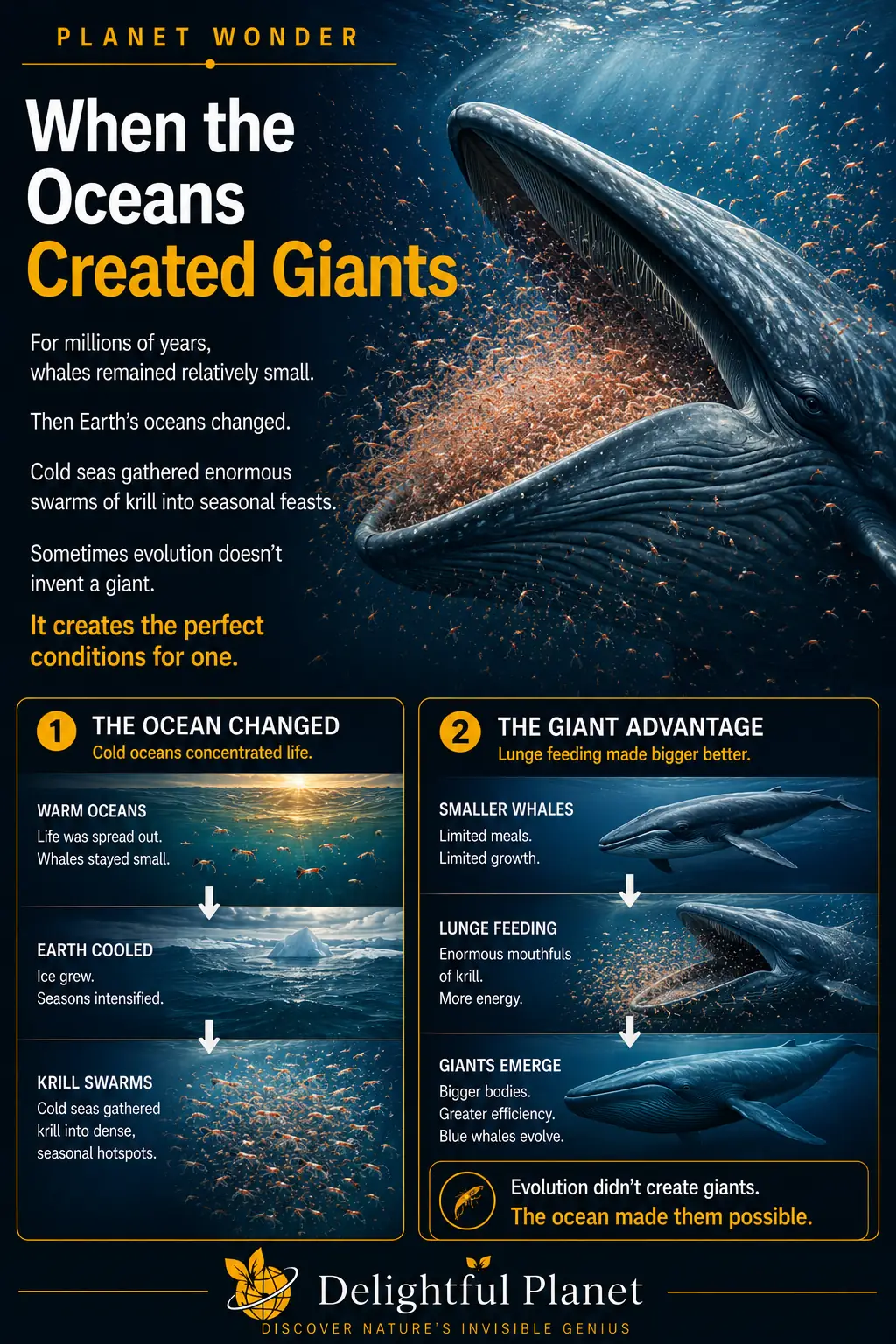
The blue whale is the largest animal that has ever lived — larger than any dinosaur, larger than anything the fossil record has yet found. It reaches thirty meters in length and more than 100 tonnes in mass. It achieved this size not through any single dramatic adaptation but because, roughly three million years ago, Earth's oceans reorganized themselves in a way that made being enormous suddenly, decisively advantageous.
The mechanismFor most of their evolutionary history, baleen whales were relatively small. The early mysticetes — the filter-feeding lineage that would eventually produce blue whales — had been evolving for tens of millions of years without growing particularly large. They were competent filter feeders, but the food was spread across warm, stratified oceans with no particular reason for prey to concentrate in one place. Modest size was sufficient. Then, during the Plio-Pleistocene transition beginning around three million years ago, the world cooled. Ice sheets expanded. Ocean circulation patterns shifted. And the critical change — the one that restructured marine food webs — was the intensification of seasonal coastal upwelling.
Upwelling occurs where wind drives surface water offshore, drawing cold, nutrient-rich water up from the deep. When this process intensifies and becomes more seasonal, its effects compound: nutrients surge to the surface in pulses, phytoplankton blooms explosively in the sunlit zone, zooplankton follows the phytoplankton, and krill — the small crustaceans that form the base of the food web for large baleen whales — aggregate into enormous, dense, seasonally predictable swarms. The ocean had not simply become more productive. It had reorganized its productivity into patches: concentrated, temporary, and enormous.
A lunge-feeding whale engulfs a mass of prey-laden water and filters it through baleen plates. The critical insight from the biomechanics research is that this system scales with body size in an asymmetric way: engulfment capacity increases far faster than body length — roughly as the cube of length — while the baleen filter area increases much more slowly. A larger whale takes a disproportionately bigger gulp per lunge. In a world where krill are dense and concentrated, that asymmetry becomes an enormous advantage: each lunge returns far more energy than the lunge costs, and the surplus grows with body size. Bigger whales, in dense prey patches, feed more efficiently than smaller ones.
The critical qualifier is prey density. In sparse or diffuse prey fields, the same scaling works against the whale — the cost of the lunge cannot be recovered from a small or scattered catch. The system only works when prey is dense enough to fill the engulfment volume profitably. Intensified upwelling created exactly those conditions: dense, seasonal krill aggregations large enough to reward the energetics of a very large animal. The ocean had, in effect, built the infrastructure for gigantism. Evolution filled the available space.
Gigantism evolved independently — and recently
The clade-wide shift toward larger body size in baleen whales is documented in research by Slater, Goldbogen, and Pyenson published in Proceedings of the Royal Society B in 2017. Using phylogenetic macroevolutionary models fitted to living and fossil species, they showed that the body size shift was temporally linked to the onset of seasonally intensified coastal upwelling — and that it happened independently in multiple lineages. The blue whale did not descend from a single giant ancestor. Several separate whale lineages all grew large around the same time, driven by the same oceanographic change.
The flip side of the same transition is the near-disappearance of small baleen whales. The diminutive Cetotheriidae — small filter feeders that had diversified successfully for millions of years — declined sharply around three million years ago. The new ocean favored giants and marginalized the small. It was not that small whales failed. The ecology changed around them.
The blue whale operates on what researchers have described as an energetic knife's edge. Its metabolism is scaled to exploit dense prey concentrations during seasonal feeding windows, accumulating blubber reserves large enough to sustain it through months of fasting or low-productivity migration. The system works when krill swarms are dense and localized. It becomes precarious when they are not. Climate-driven changes to ocean circulation are already shifting upwelling patterns and altering the seasonal predictability that the whale's foraging strategy depends on — and these are the same ocean dynamics that created the whale in the first place.
There is a deeper lesson in the timing. Baleen whales had possessed the basic machinery for filter feeding for more than twenty million years before gigantism appeared. The anatomy was there. The baleen was there. The lunge-feeding capability was there. What was missing was the ecological context that made large size advantageous rather than merely possible. When the ocean provided that context, body size increased — across multiple lineages, simultaneously, within a geologically brief window. The animal did not wait for a mutation. It waited for the world.
The blue whale is not an accident of biology. It is a consequence of oceanography. The largest animal that has ever lived exists because three million years ago, seasonal winds began blowing differently over continental shelf breaks, cold water began rising more intensely from depth, and krill began gathering in swarms dense enough to make being very large the most profitable thing an animal could be.
When the oceans changed, the whales changed with them. The blue whale is not a product of evolution alone — it is a product of oceanography.