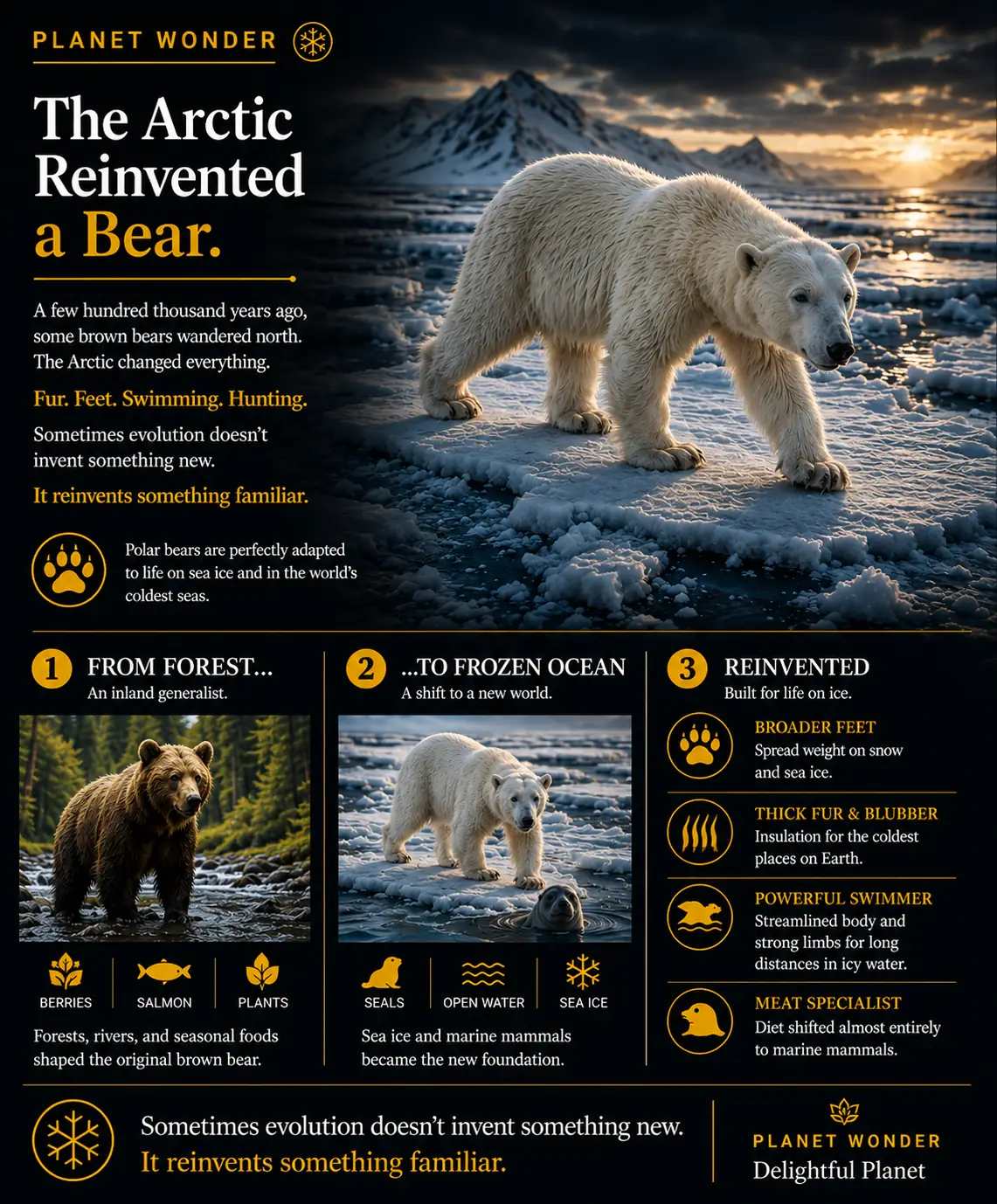
Between 343,000 and 479,000 years ago — a relatively recent moment in evolutionary time — some brown bears extended their range north into the Arctic. What happened next is one of the most rapid large-mammal transformations in the fossil record. The bear that emerged looks nothing like its ancestor and lives nowhere its ancestor could survive. The Arctic did not simply test the bear. It rebuilt it.
The mechanismThe transformation is documented across multiple systems simultaneously. The fur changed: brown bears have solid, pigmented guard hairs; polar bears grew hollow, colorless guard hairs over a dense underfur that together trap a thick layer of still air against the body — one of the most effective biological insulators known. Beneath the fur, the skin is black, maximizing absorption of solar radiation on the rare occasions the sun reaches the Arctic. The guard hairs do not, as a persistent myth once suggested, act as fiber-optic conductors channeling ultraviolet light to the skin — physicist Daniel Koon's direct measurements showed that less than 0.001% of light travels even an inch down a hair shaft, far too little to function as an optical system. The insulation is structural, not optical: air trapped in the fur, blubber beneath the skin.
The feet changed: polar bear paws are broader than those of brown bears, distributing weight across ice and snow. The pads carry small soft papillae — tiny bumps that grip ice the way rubber studs grip a playing field. The paws are partially webbed, making them effective paddles. A polar bear has been tracked swimming continuously for nearly ten days, crossing 687 kilometers of open water in the Beaufort Sea — a distance documented by US Geological Survey researchers and confirmed in the journal Polar Biology.
The diet changed completely. Brown bears are omnivores — berries, fish, insects, roots, and opportunistic meat. The polar bear subsists almost entirely on marine mammals, primarily ringed seals and bearded seals, consuming their blubber-rich carcasses in quantities that would kill a human by cardiovascular disease within years. A 120,000-year-old fossil polar bear jawbone showed the species was already fully dependent on marine prey by then — meaning these dietary and metabolic changes occurred within the first few hundred thousand years of divergence.
The most striking adaptation is invisible. Genomic analysis published in Cell in 2014, comparing 89 complete polar bear and brown bear genomes, found that the polar bear lineage shows stronger positive selection than the brown bear across a wide range of genes — and that nine of the top sixteen genes under strongest selection are associated with cardiomyopathy and vascular disease in humans. The most strongly selected gene of all is APOB, which encodes the primary protein in LDL — the so-called "bad cholesterol." The polar bear's version of this gene appears to have been modified to allow lifelong consumption of extreme dietary fat without the arterial plaques and cardiovascular disease that would result in any other mammal eating the same diet. The bear evolved, at the genomic level, a cardiovascular system that can handle what its prey demands of it.
Evolution's speed — and what triggered it
The divergence of polar bears from brown bears — 343,000 to 479,000 years ago — coincides with a particularly warm 50,000-year interglacial period known as Marine Isotope Stage 11. The hypothesis is that warming conditions extended brown bear range farther north; when the interglacial ended and severe glacial cold set in, a population of brown bears in the high Arctic became ecologically isolated and faced survival pressure so extreme and so specific that rapid adaptation was the only alternative to extinction.
The result is an animal whose entire genome bears the signature of that pressure. The polar bear is not a modified brown bear with a few additional features. It is a wholesale reconstruction of a mammal for a completely different ecological niche — achieved, in geological terms, almost overnight. For context: the evolutionary distance between polar bears and brown bears is roughly one-tenth the distance between chimpanzees and humans. In that span, the Arctic remade an inland generalist into the apex predator of the frozen ocean.
The two species can still interbreed — producing fertile hybrid offspring known as grolar or pizzly bears — which is itself a measure of how recent the divergence was. Genomic analysis has found that all living brown bears carry some polar bear ancestry from hybridization events that occurred during a warm interglacial period more than 100,000 years ago, when sea ice retreated and the ranges of the two species overlapped. The genetic exchange was not symmetric: polar bear genomes today carry no detectable brown bear ancestry, suggesting that brown bear genes reduce fitness for Arctic life sufficiently that they were eliminated by selection.
This asymmetry carries a precise implication. The polar bear's adaptations are not a loose collection of traits that happen to be useful in the Arctic. They form an integrated system — cardiovascular, metabolic, insulative, locomotive — in which each component is tuned to the others and to the specific demands of life on sea ice. Brown bear ancestry disrupts that integration. The system only works as a whole.
What the fossil record and genomics together show is that evolution, given extreme enough conditions and sufficient isolation, can transform the fundamental architecture of a large mammal in geological blink. The polar bear is the evidence. The Arctic was the pressure. A few hundred thousand years was enough.
The Arctic reinvented a bear. And the bear it made has no equal on Earth.