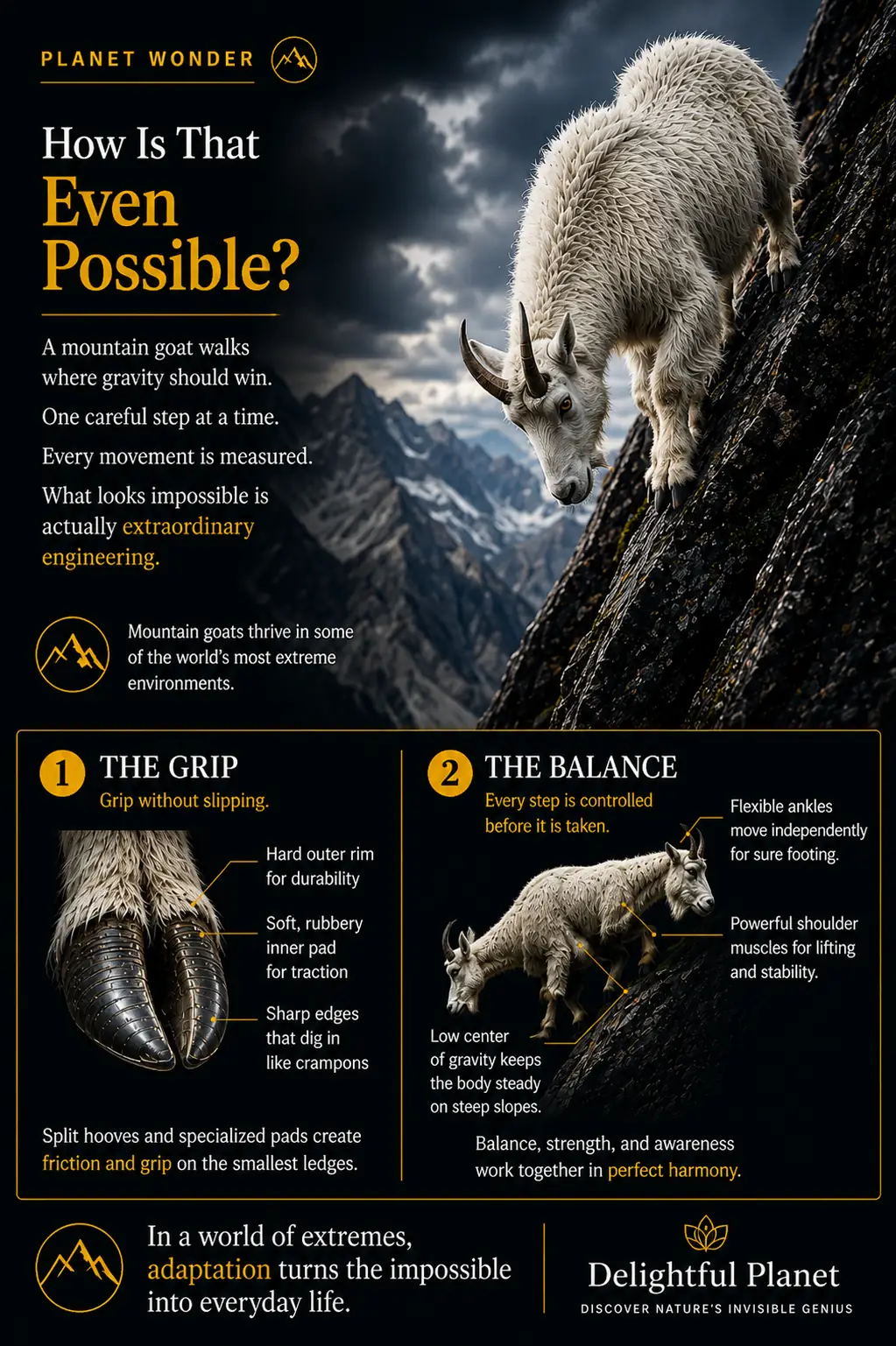
A mountain goat descends a nearly vertical cliff face at a steady walk, each hoof placed with deliberate precision on ledges that would be invisible to anything below. It is not scrambling. It is not struggling. It moves the way a person walks on a sidewalk — with the calm of an animal doing something ordinary in a context that looks impossible. The terrain that keeps its predators at a safe distance is simply where it lives.
The mechanismThe hoof is where the system begins. Each of the mountain goat's two front toes is shod in hard keratin — the same protein as a horse's hoof — forming a rigid outer rim that can catch and hold on the smallest rock feature: a crack, a protrusion, an edge measured in millimeters. Inside that rim, slightly protruding past the nail, sits a soft, rubbery pad with a rough textured surface. On smooth rock or ice, the pad deforms against the surface, creating friction the way a rubber sole grips a wet floor. The hard edge catches; the soft pad holds. They perform different functions simultaneously, on surfaces that no single material could reliably grip.
The split between the two toes adds a third mechanism. When a hoof lands on a sloped surface, the toes can spread apart, creating a braking effect that resists sliding. If one toe loses contact, the other maintains grip — a redundancy built into the geometry of the foot itself. Higher up on the pastern — the ankle joint — two small dewclaws project backward. On steep descents, these make contact with the rock as an additional brake, preventing the hoof from slipping forward under the animal's weight.
The body above the hooves is configured to use them effectively. Mountain goats are stocky and compact, with short legs relative to body mass. This keeps the center of gravity low and close to the cliff face, reducing the rotational force that would tip a taller animal off a ledge. The shoulder and neck muscles are disproportionately large — confirmed by biomechanical analysis of climbing footage by researchers at the University of Calgary — and provide the upward propulsive force that moves the animal up steep inclines. During a pull-up phase on a cliff, the goat's elbow locks in close proximity to its center of mass, so that extending the joint translates directly into upward body movement with minimal wasted motion.
The elevation is not incidental to the mountain goat's survival — it is the strategy. The cliffs and near-vertical terrain that the animal inhabits year-round serve as refuge from predators: mountain lions, wolves, and bears cannot follow where mountain goats go. The hoof system is, in this sense, a defense mechanism as much as a locomotion system. The animal has traded access to richer lowland feeding grounds for the security of terrain that nothing else can reach. Every adaptation in its body is the price of that trade — and every one of them has been paid.
Not a true goat — and not related to domestic goats
Despite the name, the mountain goat (*Oreamnos americanus*) is not a true goat. It belongs to the subfamily Caprinae — the goat-antelope group — but is more closely related to the serow and chamois of Europe and Asia than to the domestic goat. It is the only species in the genus *Oreamnos* and is endemic to the mountainous regions of western North America — the Rocky Mountains, the Cascades, and adjacent ranges — where it lives at elevations from the subalpine zone up to the permanent snowline.
Both sexes grow short, sharp black horns that are never shed — unlike antlers, horns are permanent structures of bone covered in keratin. The mountain goat uses these horns for social competition, not for predator defense. Its defense is the cliff.
Engineers working on climbing robots and footwear for vertical terrain have studied the mountain goat hoof directly. The US patent literature includes at least two patents for footwear designed to replicate the hard-rim, soft-pad geometry — attempting to capture its ability to work across both hard rock edges and smooth icy surfaces with a single structure. The challenge is what makes the biological solution remarkable: the goat's hoof combines materials with fundamentally different mechanical properties in a single continuous structure that grows, wears, and self-maintains across the animal's lifetime. That spatial relationship between pad and nail — precise to a fraction of a millimeter — is achieved biologically, without any manufacturing tolerance or quality control.
The biomechanical study published in Zoology in 2016 by Lewinson and Stefanyshyn at the University of Calgary was the first to quantify mountain goat climbing mechanics from field video rather than captive observation. Their analysis found that the shoulder does not function as the primary pivot point during climbing — as researchers had assumed — but that the elbow and carpal joints play the central role in translating muscle force into upward body movement, keeping mass directly over each contact point with minimal mechanical waste.
The mountain goat does not choose difficult terrain because it is adventurous. It lives there because nothing else does. Everything about its body — hoof, ankle, shoulder, mass distribution — is a solution to the problem of permanent residence at altitude. The cliff face is not the challenge. It is the answer.
How is that even possible? One careful step at a time. Precisely.