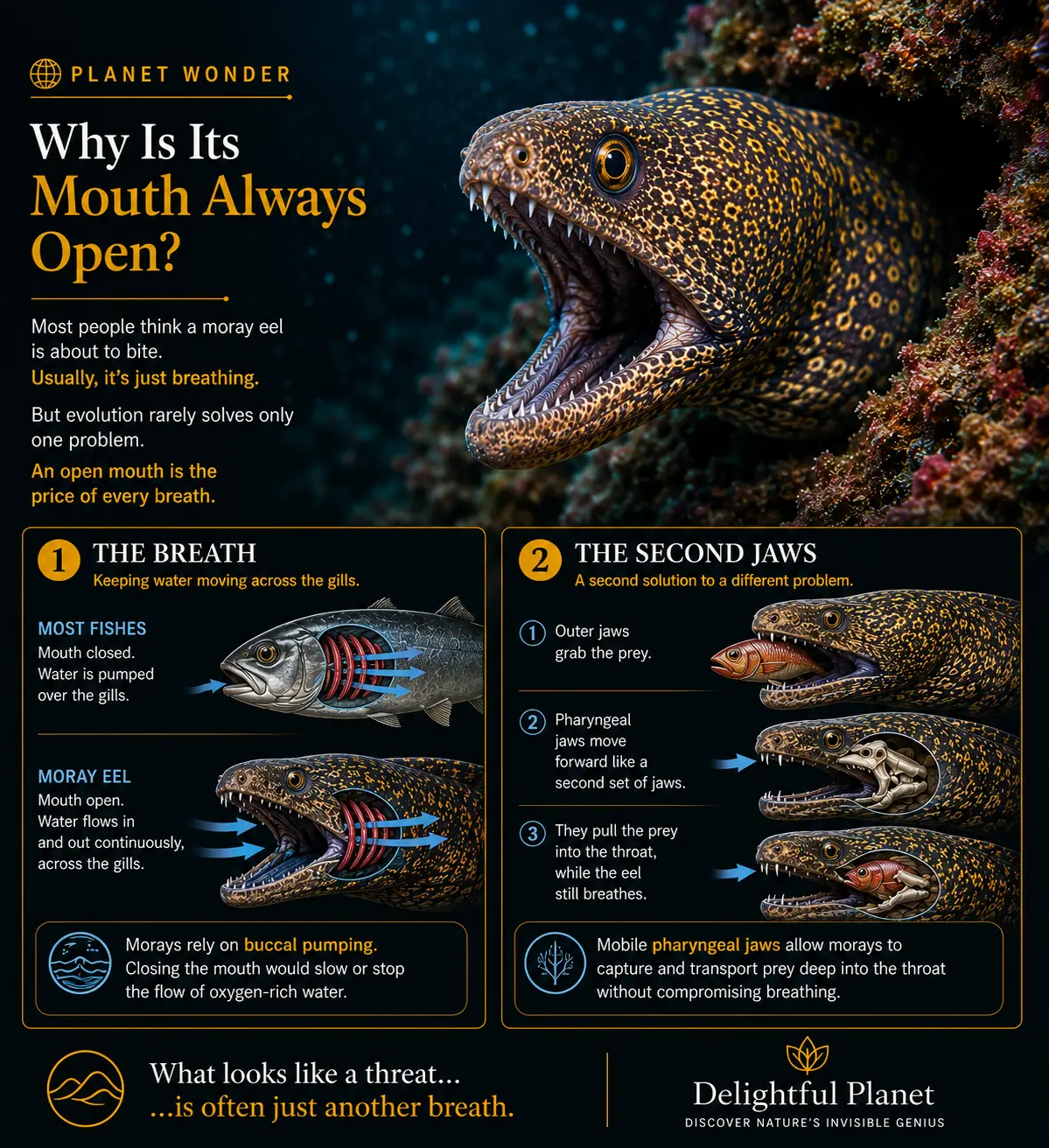
A moray eel stares out from a crevice in the reef, mouth open, teeth visible, looking every bit like something about to strike. Most divers interpret it as a threat display and give the animal a wide berth. But the moray is almost certainly not threatening anyone. It is breathing. The open mouth is the price of every breath — an anatomical constraint that evolution has, characteristically, turned into an advantage.
The mechanismMost bony fish breathe through a two-part pump. The mouth opens to draw water in; the operculum — a bony plate covering the gills — pumps water out across the gill surfaces. Moray eels have reduced gill openings and lack the large, mobile operculum that makes this two-stage pump efficient in other species. To compensate, they rely more heavily on buccal pumping: actively moving water through the mouth and over the gills by cycling the jaw open and closed. The mouth must stay partially open to maintain continuous water flow. Closing it would reduce or interrupt the ventilation that keeps the gills supplied with oxygen. The gaping jaw is not aggression. It is respiration.
The second mechanism is entirely separate, and was unknown to science until 2007. Moray eels cannot generate the powerful suction that most bony fishes use to pull prey into their throats — their long, narrow bodies and the confined spaces they inhabit make the rapid expansion required for hydraulic suction mechanically impractical. The solution they evolved is documented in a paper by Mehta and Wainwright published in Nature: a second set of jaws, located in the throat, that can project forward into the oral cavity, seize prey that the outer jaws have caught, and drag it back toward the esophagus.
These pharyngeal jaws — derived from gill-arch bones and armed with recurved, backward-pointing teeth — are the only known case in any vertebrate of a second jaw apparatus being used both to restrain and to transport prey. The outer jaws grip the animal; the pharyngeal jaws launch forward, hook into the prey, and pull it inward. The outer jaws release at the moment the pharyngeal jaws engage. The whole sequence takes fractions of a second. The prey has no meaningful opportunity to escape once contact is made.
The two systems solve different problems independently. Buccal pumping addresses the respiratory constraint created by reduced gill covers — the mouth must open, so it opens. Pharyngeal jaw projection addresses the feeding constraint created by a long, narrow body — hydraulic suction cannot work efficiently in such a body plan, so the throat comes forward to meet the prey instead. Neither system was designed to work with the other. But the two operate independently of each other: the open mouth that breathing requires is also the open mouth through which the pharyngeal jaws deploy. The moray breathes through an open jaw, and it hunts through the same opening — an integration that has made moray eels among the most effective ambush predators in reef ecosystems.
The discovery that changed how we understood vertebrate feeding
Before Mehta and Wainwright's 2007 Nature paper, it was known that moray eels had pharyngeal jaws — all bony fishes do, in some form. What was not known was that moray pharyngeal jaws could protrude forward into the oral cavity. In all other teleost fishes, pharyngeal jaws stay at the back of the throat and process prey that hydraulic suction has already delivered to them. The moray's version reverses this: the prey is held in the mouth, and the throat comes forward to collect it.
Mehta and Wainwright used high-speed video and X-ray fluoroscopy — real-time X-ray imaging of a feeding eel — to document the movement. The paper described the discovery as "the first described case of a vertebrate using a second set of jaws to both restrain and transport prey." The imaging technology made visible what centuries of observation of live morays had entirely missed. The jaws move too fast for the naked eye to follow.
The moray's feeding system has attracted interest from robotics engineers designing gripper mechanisms for confined spaces — environments where a robot arm cannot expand outward to generate suction but must project inward from a fixed position. The moray's solution — a second mechanical element that launches forward from a fixed housing, engages a target, and retracts — maps directly onto certain gripper design problems. Several research groups have used the pharyngeal jaw kinematics as a reference model for articulated end-effectors.
National Geographic's description of the pharyngeal jaws as reminiscent of the Alien films is not accidental — the comparison has been made by researchers themselves. The jaw that emerges from within another jaw, armed with recurved teeth, is genuinely without parallel in the vertebrate world. The moray eel has been living in reef crevices for tens of millions of years, and its inner jaw was discovered only nineteen years ago.
Worth being precise here: not every moray species uses pharyngeal jaw projection in exactly the same way — the morphology varies across the more than 200 species in the family Muraenidae, and the original study was conducted on the reticulate moray (*Muraena retifera*). The core mechanism — pharyngeal jaws capable of projecting forward to transport prey — is confirmed across the family, but the degree of mobility and the tooth morphology differ by species and diet. The open mouth, however, is universal. Every moray that breathes, breathes with its jaw open.
What looks like a threat is almost always just another breath.