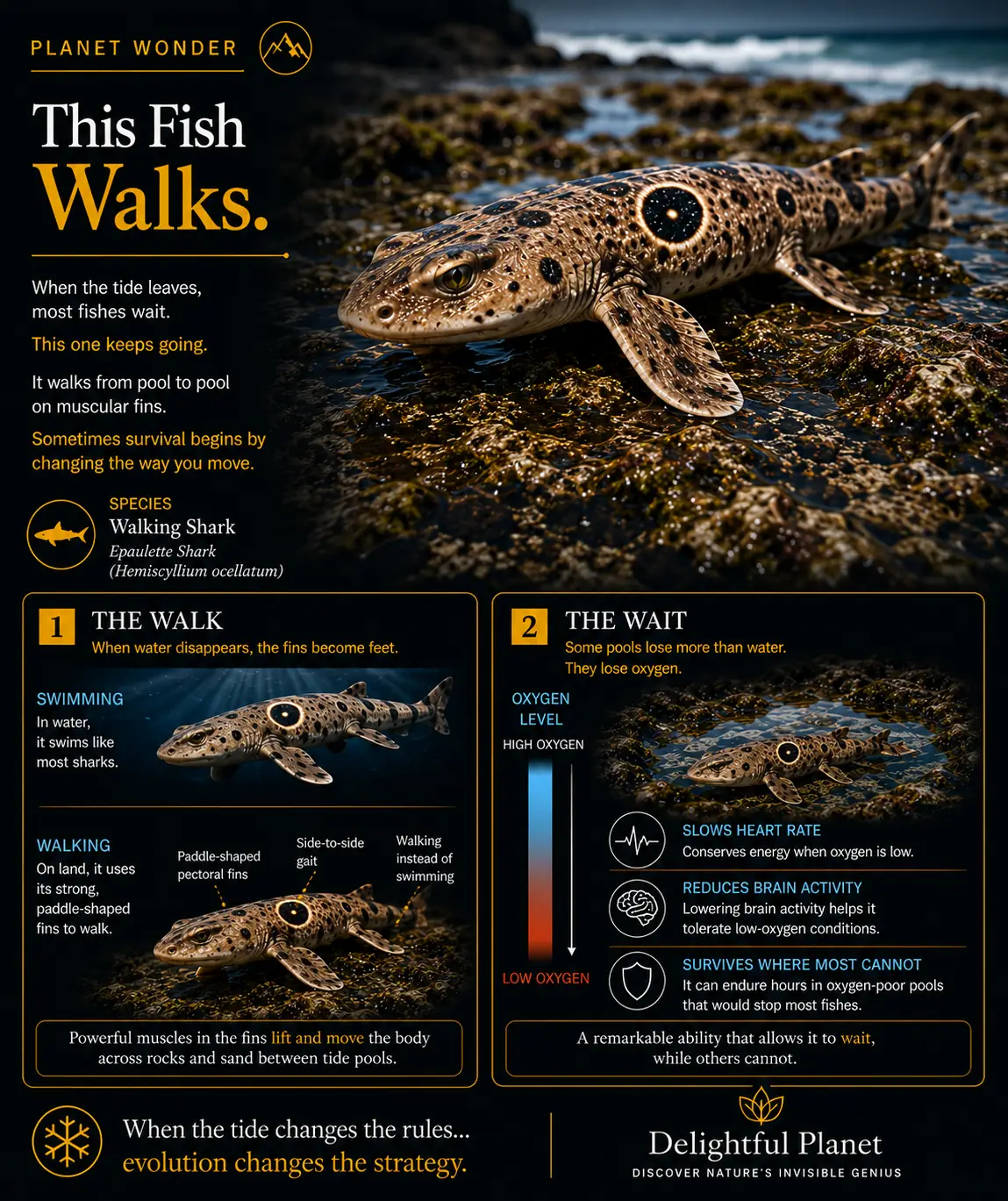
When the tide goes out on the shallow reefs of Australia and New Guinea, most fish retreat with the water or wait in whatever pool remains. The epaulette shark does something else. It lifts itself on its broad pectoral fins, bends its body from side to side, and walks — across exposed rock, across sand, from one tide pool to the next — until it finds what it needs. It is a shark. It is walking on land. And it does this routinely, as a normal part of its night.
The mechanismThe epaulette shark (*Hemiscyllium ocellatum*) is a small species — typically under a meter long — belonging to the family of longtailed carpet sharks. Its paired pectoral and pelvic fins are broad and paddle-shaped, with a cartilaginous internal framework that is reduced and separated compared to other sharks, allowing the fins to rotate and be used as limbs. When walking, the shark plants a pectoral fin, pushes off the substrate, swings the opposite pelvic fin forward, and advances — bending its body laterally with each stride. The gait is convergently similar to that of salamanders, a pattern that appears to have arisen independently in this fish lineage. It walks this way not only on land but also along the seafloor when submerged, often preferring to walk even when the water is deep enough to swim.
The second adaptation addresses a different problem entirely. When tide pools become isolated at low tide — particularly at night — photosynthesis stops, respiration continues, and the oxygen in the trapped water can fall dramatically. Some pools approach anoxia within hours. Most fish cannot survive this. The epaulette shark can. It tolerates several hours of severe hypoxia and up to two hours of complete anoxia without the neurological damage that would result in any mammal and most other fish.
The physiological strategy involves multiple coordinated responses. Heart rate slows, conserving oxygen demand. Blood pressure drops — studies by Söderström, Renshaw, and Nilsson published in the Journal of Experimental Biology in 1999 showed a 50% decrease in blood pressure during severe hypoxia — but compensatory vasodilation in the brain's blood vessels maintains cerebral blood flow despite the systemic drop. Non-essential neural activity is selectively suppressed — the brain shuts down functions it does not need to survive, prioritizing core processes. Brain ATP levels remain stable even during anoxia, which is the key marker of protection: the brain is not running out of fuel. When oxygen returns, the shark resumes normal function.
The two adaptations solve two different problems that arise from the same environment. Walking solves the mobility problem: when water disappears, most fish are stranded, but the epaulette shark can relocate. Hypoxia tolerance solves the oxygen problem: when water remains but oxygen doesn't, most fish suffocate, but the epaulette shark waits. Together they give this small reef fish access to a niche that almost nothing else can occupy — the exposed and hypoxic margins of a coral reef at low tide — where food is available and competition is minimal precisely because the conditions are otherwise lethal.
What this tells us about the fish-to-land transition
The epaulette shark's walking gait has attracted attention from researchers studying the evolutionary origins of tetrapod locomotion — the transition from fish to land-dwelling vertebrates that occurred roughly 375 million years ago. The side-to-side body bending and alternating fin placement of the epaulette shark is convergently similar to the gait of early tetrapods, suggesting that the basic neural and muscular architecture for this type of movement may predate the fin-to-limb transition. The shark did not inherit this from a common ancestor with salamanders — the two lineages diverged far earlier. It arrived at a similar solution independently, which is evidence that this particular pattern of movement is mechanically favored for navigating complex substrates.
There are nine known species of walking shark in the genus *Hemiscyllium*, all found in the waters of Australia, Indonesia, and Papua New Guinea. New species continue to be discovered in the species-rich Coral Triangle region. The most recent molecular analysis suggests these sharks have been diversifying relatively recently — within the last few million years — making their walking ability a surprisingly young evolutionary innovation for a group of animals that has existed for hundreds of millions of years.
The epaulette shark's hypoxia tolerance has attracted serious interest from biomedical researchers, for the same reason that any vertebrate that can survive anoxia without brain damage is extraordinary. The central challenge in treating stroke and cardiac arrest in humans is protecting the brain from the damage that occurs when oxygen is cut off — even brief periods of anoxia cause the rapid depletion of ATP and the cascade of neurological injury that follows. The epaulette shark does not experience this cascade. Its brain ATP remains stable during anoxia. Understanding how it achieves this — the role of adenosine signaling, selective neural suppression, and metabolic depression — is an active area of biomedical research.
The walking mechanism has attracted equally practical attention. Robotics researchers studying locomotion on complex, irregular terrain have used the epaulette shark's gait as a reference model — a system that produces reliable terrestrial movement using a body plan not designed for land, through fin geometry and lateral body undulation rather than the vertical force generation of limbs. The shark solves the problem of walking without legs. Several groups have built robots that replicate aspects of this fin-based walking to navigate surfaces that wheeled or legged robots cannot reliably cross.
The epaulette shark is not a large, dramatic animal. It is small, nocturnal, and spends most of its time in places few observers reach. But it does two things that almost nothing else can do — walk on land and survive without oxygen — and it does them together, in the same body, in response to the same tide. The reef margin at low tide is its domain. Every other animal gave it up when the water left.
This fish walks. And when it can't walk, it waits — in water that would end most things.