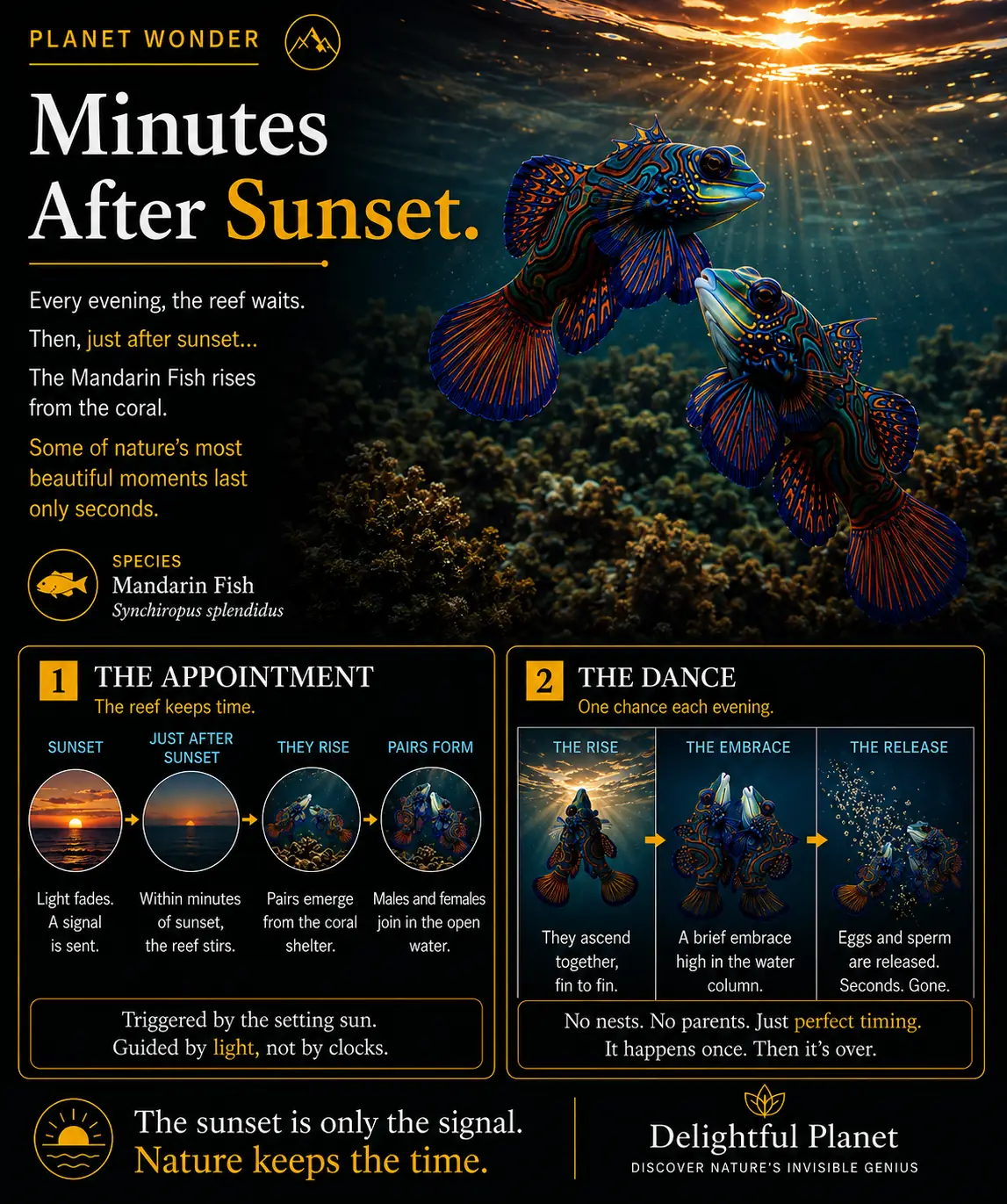
Every evening at sunset, in the shallow reefs of the western Pacific, something brief and precise occurs. The mandarin fish — one of the most vividly colored animals on Earth — emerges from the coral rubble where it spends its days and rises into open water. Within minutes of the light fading, pairs form, ascend together, and release eggs and sperm simultaneously into the water column. Then it is over. The whole event lasts seconds. And it happens again tomorrow, at the same time, triggered by the same signal: the fading of the sun.
The mechanismThe timing is photoperiod-driven. As light levels drop at sunset, the change in illumination serves as the environmental cue that initiates spawning behavior. Males gather at established sites on the reef in the minutes before and after sunset. A male approaches a female, the pair ascend belly-to-belly through the water column, and at the height of the rise — brief, measured in seconds — eggs and sperm are released simultaneously for external fertilization. The eggs are small, buoyant, and pelagic: they drift with the current, away from the reef and the predators concentrated there. Females spawn once each night. Males, which are typically larger, may spawn multiple times in a single evening with different partners.
The precision of the timing is not coincidental. Spawning at exactly the transition from day to night minimizes the window during which the released eggs are vulnerable to visual predators on the reef — predators whose effectiveness drops rapidly as ambient light fails. The eggs are released into falling darkness and carried away. By the time light returns, they are dispersed and beyond the reef's concentrated predator community.
The animal performing this ritual is itself biologically unusual in a way that has nothing to do with its behavior. The mandarin fish (*Synchiropus splendidus*) is one of only two vertebrate species known to produce the color blue through actual cellular pigment rather than structural color. In virtually every other vertebrate — every blue bird, every blue frog, every blue fish — the blue is produced structurally: light reflecting off nanostructures in the skin or feathers, with no blue pigment present. The mandarin fish contains specialized cells called cyanophores, which carry blue-pigmented organelles called cyanosomes. The blue is not an optical illusion produced by the arrangement of reflective surfaces. It is a genuine pigment, chemically absorbing non-blue wavelengths and reflecting blue, of a type found elsewhere in the vertebrate world only in its close relative, the psychedelic mandarin (*S. picturatus*).
This makes the mandarin fish's coloration as biologically unusual as its behavior. The cyanophore was first described and named by Goda and Fujii in a 1995 paper in Zoological Science, following microscopic examination of the mandarin fish's skin. Before that paper, the existence of a true blue chromatophore in vertebrates was unknown. The animal had been seen and studied for decades. Its color had been admired and photographed. Nobody had looked closely enough at the cells producing it to realize that something in those cells was genuinely unprecedented.
The spawning window — and what makes it work
Field research by Sadovy and colleagues, involving over 400 hours of underwater observation at mandarin fish spawning sites, confirmed the polygamous mating system and the precise sunset timing. Males are polygynous — a single male may spawn up to eight times in one evening with different females. Females are sequentially polyandrous — they spawn once per night, selecting partners based partly on male size. The largest males spawn most frequently.
The mandarinfish is scaleless, relying on a thick, bitter-tasting mucus coating for protection against parasites and predators in place of the scales most fish carry. The mucus contains a skin toxin that deters most would-be predators. The vivid coloration is thought to function as aposematic signaling — advertising that toxicity to predators that have learned to associate the pattern with unpalatability.
The cyanophore discovery has implications beyond the mandarin fish itself. The existence of a true blue pigment in a vertebrate — one whose chemical identity remains incompletely characterized — opens questions about the evolution of color production across the vertebrate tree. If a blue pigment can evolve in two species of callionymid fish, it may have evolved elsewhere and not yet been identified; the standard assumption that vertebrate blue is always structural may be premature. Several research groups have since searched for cyanophore-like cells in amphibians and other fish, with inconclusive results. The question is not fully settled.
The spawning behavior raises a complementary question about precision timing in marine reproduction. Spawning at a specific light-transition window rather than at a fixed time of day requires continuous monitoring of ambient light levels and the ability to translate a specific rate of light change into a behavioral trigger. The mechanism by which this is achieved in the mandarin fish — the photoreceptors involved, the neural pathway from light detection to behavioral output — has not been fully characterized. What is known is that the signal works: every evening at sunset, reliably, across the range of the species, the fish rises.
The mandarin fish spends its days hidden in coral rubble, feeding on small crustaceans, nearly invisible to observers. For a few seconds each evening it becomes one of the most visible animals on the reef — vivid, paired, ascending — and then it is gone. The brevity is part of the strategy. The window is small because it needs to be.
Minutes after sunset, the most colorful fish in the sea rises, pairs, and vanishes. Every day. On schedule.