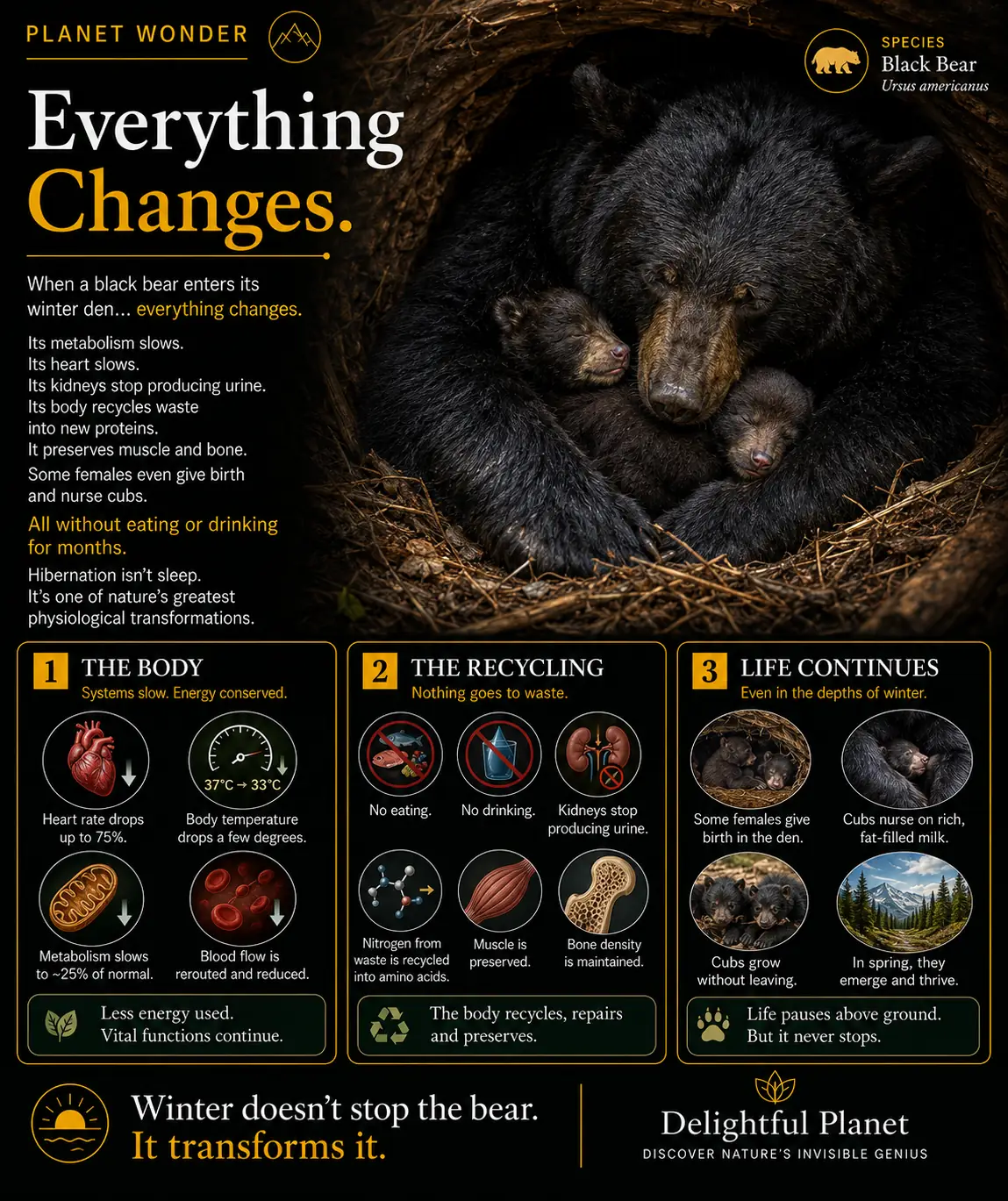
A black bear enters its winter den in autumn and emerges in spring having not eaten, drunk, urinated, or defecated for five to seven months. It has lost body mass but retained most of its muscle. Its bones are intact. It can walk out of the den and begin foraging within days. What happened inside the den during those months is not sleep. It is one of the most sophisticated physiological transformations in the animal kingdom — a coordinated, reversible remodeling of nearly every major organ system in the body.
The mechanismThe numbers from the den are striking. Metabolism drops to approximately 25% of basal rates — confirmed in peer-reviewed measurements published in Science in 2011 by Tøien and colleagues, who monitored free-ranging black bears in outdoor hibernacula for five months using implanted sensors. Heart rate falls from around 55 beats per minute to as few as 9 — a reduction of over 80% — with a pronounced sinus arrhythmia in which the heart almost stops between breaths and briefly accelerates when the bear inhales. Body temperature drops only modestly, from 37–38°C to a mid-hibernation average of around 33°C, cycling slowly across a 30–36°C range over multi-day periods. The bear is not cold. It is running its body at minimum power while keeping it warm enough to respond quickly if threatened.
The kidneys present a separate puzzle. In any other mammal, five months without urination would be fatal — waste nitrogen accumulates in the blood, producing the toxicity of uremia. The bear avoids this through a recycling system of remarkable efficiency. Urea — the primary nitrogen waste product — is not excreted. Instead, it is transported back into the intestine via urea transporters in the bladder wall, hydrolyzed by gut microbes, and the released nitrogen is reabsorbed and resynthesized into amino acids and new muscle protein. Bears recycle nearly 100% of the urea they produce during hibernation. The waste product becomes the raw material. Nitrogen that would otherwise be lost in urine is redirected into maintaining lean body mass.
Muscle and bone follow the same logic. Five months of inactivity in any other large mammal would produce profound muscle atrophy and significant bone loss — the consequences of disuse that any bedridden patient experiences within weeks. Hibernating black bears show neither. Gene expression studies have found that the signaling pathway responsible for protein synthesis — mTORC1, activated by branched-chain amino acids — remains active in hibernating bear muscle, maintaining protein turnover at rates comparable to summer levels. Bone resorption and formation remain balanced throughout hibernation, maintaining bone density and calcium homeostasis simultaneously. The bear emerges in spring with the musculoskeletal capacity to forage, fight, and mate within days.
A female black bear may do something during hibernation that makes the physiology still more remarkable: give birth. Cubs arrive in the den in January or February — tiny, blind, and helpless — and nurse on fat-rich milk from a mother consuming nothing. Implantation is delayed until hibernation begins, so active fetal development and cub rearing occur entirely within the dormancy period, sustained entirely by fat reserves accumulated the previous autumn.
Why medical researchers are paying close attention
The bear's hibernation physiology maps directly onto some of medicine's most persistent problems. Muscle atrophy in bedridden or immobilized patients — a consequence of disuse that accelerates in the elderly and critically ill — occurs through the same pathways that hibernating bears somehow suppress. Understanding how bears maintain mTORC1 signaling and branched-chain amino acid availability during prolonged inactivity is an active area of research in muscle-wasting disease.
The kidney story is equally compelling. Bears survive for months in a state that would be fatal uremia in humans, through a recycling mechanism that keeps blood nitrogen within safe limits without any excretion. Kidney International published a review in 2013 describing hibernating bears as "metabolic magicians of definite interest for the nephrologist" — the urea recycling system is now being studied as a potential model for managing nitrogen accumulation in patients with chronic kidney disease. The bear has solved, for its own purposes, problems that medicine is still working on.
What makes bear hibernation distinctive is the combination of deep metabolic suppression with near-normal body temperature. Small hibernators — ground squirrels, bats, dormice — drop body temperature to near freezing and reduce metabolism by 95% or more, but must periodically rewarm themselves at enormous energetic cost and cannot arouse quickly. Bears suppress metabolism by 75% while staying warm enough to give birth, nurse cubs, and respond to disturbance. The animal that emerges is capable, not depleted.
The metabolic suppression persists after emergence. The 2011 Science paper found that bears maintained a reduced metabolic rate for up to three weeks after leaving the den and returning to normal body temperature. The mechanism that allows a mammal to suppress metabolism to 25% for months and restore it gradually over weeks — without the organ damage comparable suppression would cause in a human — remains one of the more remarkable unsolved problems in mammalian physiology.
Winter doesn't stop the bear. It transforms it. And in spring, when the transformation reverses, the animal that walks out is functionally indistinguishable from the one that walked in — except that it may be carrying cubs it grew in the dark.
Winter doesn't stop the bear. It transforms it.