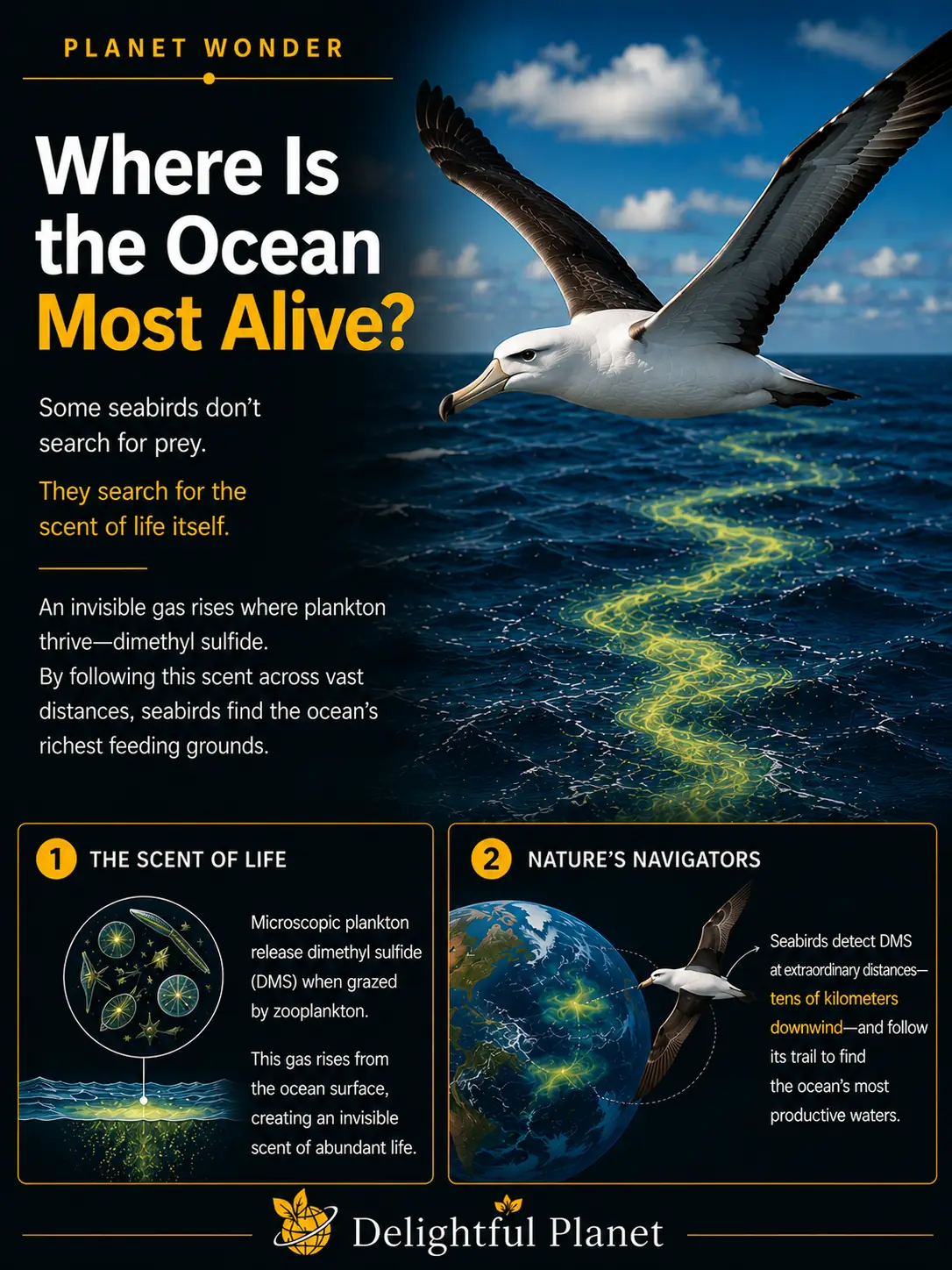
The open ocean is enormous and mostly empty. A seabird searching for food without a map, without landmarks, and without the ability to see below the surface faces a problem that seems close to unsolvable — finding prey scattered across millions of square kilometres of featureless water. Some of the most accomplished navigators on the planet have solved it not by seeing where the food is, but by smelling where the ocean is most alive.
The mechanismThe signal they follow is a gas called dimethyl sulfide, or DMS. It originates deep in the food chain, with microscopic phytoplankton — the foundation of ocean productivity. These organisms produce a sulfur compound called DMSP as part of their normal biochemistry, accumulating it in high intracellular concentrations. DMSP is released into seawater through various processes — cell death, viral lysis, normal exudation — but the rate of release increases sharply when zooplankton graze on phytoplankton. The grazing ruptures cells, releasing DMSP in bulk, and enzymes rapidly convert it to DMS. The gas rises from the ocean surface into the atmosphere, where it disperses downwind in a plume that marks the location of active grazing.
The seabirds that detect and track this signal belong to the order Procellariiformes — albatrosses, petrels, and shearwaters, collectively known as tube-nosed seabirds for the distinctive tubular nostrils running along their bills. They have the largest olfactory bulb-to-brain ratio of any birds on Earth. At sea, they cross-cut the wind in long, sweeping arcs — a flight pattern that maximizes the chance of intersecting a scent plume — then turn upwind and follow the DMS gradient toward its source. The source is zooplankton actively feeding, which means the source is food.
DMS does not mark where fish are. It marks where phytoplankton are being grazed — which is where the entire food web is most active. A productive patch of ocean concentrates zooplankton, which concentrates the fish and squid that feed on them, which concentrates the seabirds. The DMS gradient is not a direct signal of prey; it is a signal of ecosystem activity, and the seabird has learned to read it as reliably as a map. Experimental releases of DMS at sea have been shown to attract procellariiform seabirds in multiple studies, and tracking data confirm that birds aggregate in areas of naturally elevated DMS concentrations.
A signal with consequences beyond foraging
DMS is the single largest natural source of sulfur to the Earth's atmosphere, contributing roughly 27 teragrams of sulfur per year globally. In the atmosphere, DMS oxidizes to form sulfate aerosols — particles that act as cloud condensation nuclei, influencing cloud formation, albedo, and regional climate. The connection between ocean biology and atmospheric chemistry runs through this one gas: phytoplankton are grazed, DMS is released, clouds form, sunlight is reflected.
This is the same molecule guiding a petrel across the Southern Ocean and shaping the Earth's climate. It sits at the intersection of ecology, atmospheric chemistry, and animal behavior — one compound doing several large jobs simultaneously, most of them invisible to any observer without the instruments or the nose to detect them.
The relationship has a structure that researchers have described as tritrophic mutualism — a three-level interaction in which all parties benefit. Phytoplankton release DMSP; zooplankton grazing converts it to DMS; seabirds follow the DMS to find and eat the zooplankton. When seabirds eat, they defecate at sea, and research published in PNAS has presented evidence that this returns iron and other limiting nutrients to the water — nutrients that fertilize phytoplankton. Worth being precise: the iron recycling component of this mutualism is supported by evidence but remains an area of active investigation. What is established is the directional logic: the bird that found the food by smelling the ecosystem is, by eating, potentially sustaining the ecosystem that produced the smell.
The olfactory system that makes this possible is extraordinary in its sensitivity. Procellariiform seabirds can detect DMS at concentrations measured in parts per billion. Nevitt and colleagues have documented that the birds respond to DMS plumes over the open ocean at concentrations consistent with natural production — not just in controlled laboratory settings but in the field, navigating real gradients across real seas. The nose of a wandering albatross is not a blunt instrument. It is a precision sensor calibrated to read a chemical signal that encodes the productivity of the ocean below.
The DMS-foraging link is well established in procellariiform seabirds, but the degree to which individual species rely on DMS versus other cues — visual, acoustic, social — varies across the order. Not all seabirds use olfaction equally, and the exact detection ranges under natural conditions remain an area of active research. What is not in dispute is the core finding: for albatrosses, petrels, and shearwaters, an invisible gas rising from a grazed phytoplankton bloom is a reliable address for the ocean's richest feeding grounds.
And the birds that have learned to read that breath find food where nothing else could look.