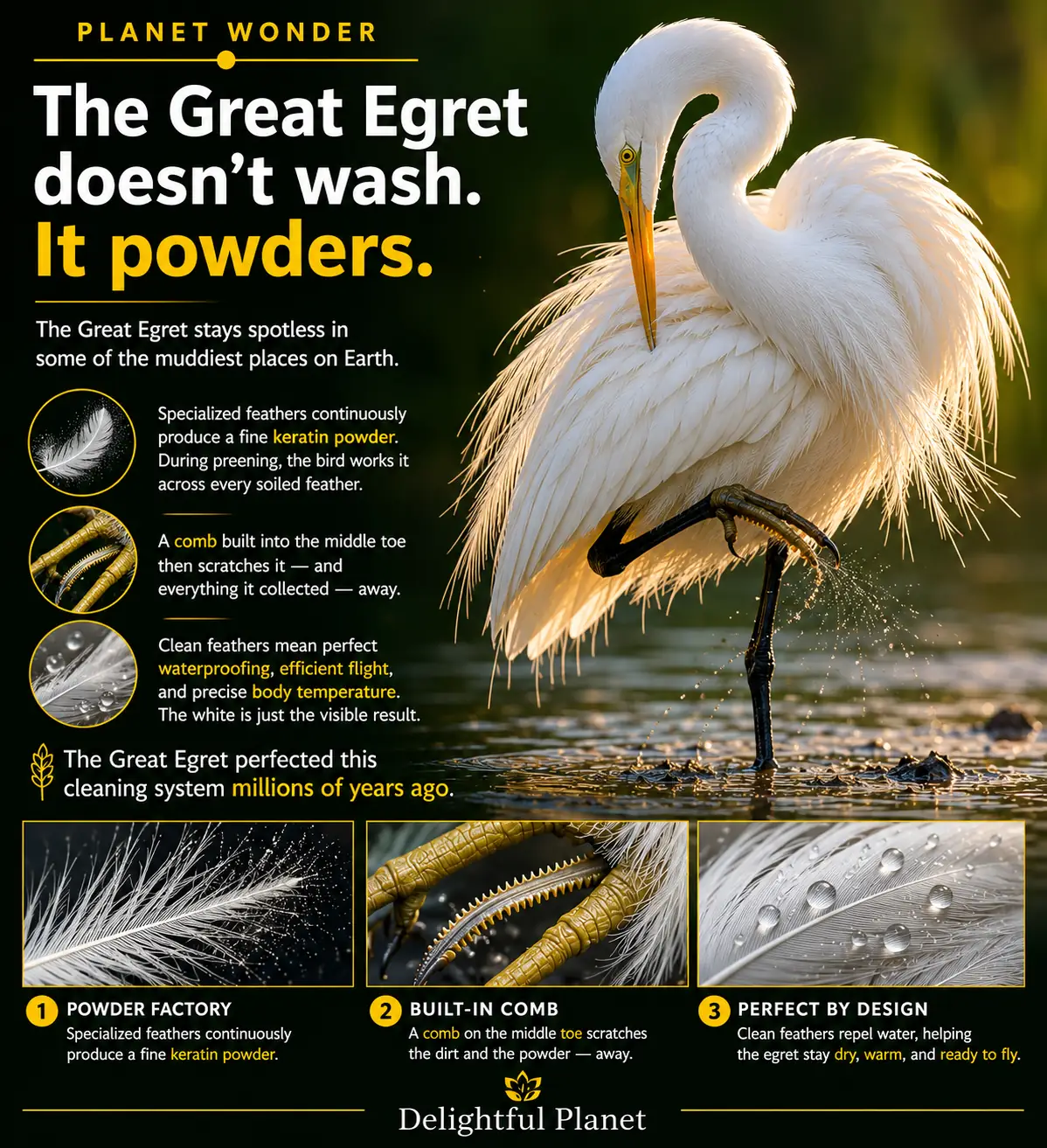
Stand at the edge of any wetland — from North America to Africa, Asia, and Australia — and watch a Great Egret work the shallows. It wades through water carrying mud, algae, fish slime, and the accumulated debris of an entire ecosystem. It catches fish with its bill — repeated contact with scales, mucus, and the oils that coat every fish that has ever lived. It does this for hours, every day. It emerges spotless.
The mechanismThe system that makes this possible is invisible from any reasonable distance. It begins with feathers that most people never notice — specialized structures tucked into patches on the bird's breast and flanks, growing continuously from the day the bird hatches until the day it dies. They never stop producing.
As they mature, their tips disintegrate into a fine keratin powder — the same protein that makes up human fingernails, ground to a talcum-like consistency by biological processes that operate without pause. During preening, the egret works this powder through its plumage with its bill, distributing it across every feather surface. The powder absorbs oils, fish slime, and the fine particulate matter that wetland life deposits on anything that moves through it. It binds to what it touches.
Then a comb — built directly into the bird's middle toe, with perfectly spaced teeth — removes the powder and everything it has absorbed, along with any parasites that have taken hold. The feather emerges clean. The process begins again immediately.
The result is not cosmetic. Clean feathers mean intact microstructure — the precise interlocking of barbs and barbules that creates the waterproof surface a wading bird depends on. A feather compromised by fish oil cannot repel water; a waterlogged bird cannot fly, cannot regulate its body temperature, and cannot hunt. The white you see from a distance is the visible evidence of a system operating exactly as it should.
A solution arrived at independently — four times
Powder down evolved separately in herons, parrots, tinamous, and bustards. These groups did not inherit the system from a common ancestor. Each lineage developed it independently, in different habitats, across different evolutionary timescales, arriving at the same answer: grow a feather that disintegrates into powder, and use the powder to clean everything else.
This is convergent evolution — nature finding the same solution through entirely separate paths. It suggests the powder down system is not an accident or an oddity. It solves a real and recurring problem, and it solves it well enough that four entirely separate lineages arrived at it independently.
Most birds solved the waterproofing problem with a uropygial gland — a structure near the tail that produces oil the bird spreads across its feathers during preening. The egret has that too. But in wetland habitats, where contact with fish, mud, and organic debris is constant and unavoidable, oil alone is insufficient. The powder down system handles what oil cannot: the specific chemistry of fish slime, which no preen oil fully neutralizes.
The exact molecular mechanism by which keratin powder interacts with fish slime at a chemical level is not yet fully characterized. Scientists know it works — the egret demonstrates that every day. The precise chemistry of why it works is still being studied. The egret is, in this sense, ahead of the research.
Engineers working on self-cleaning surfaces — textiles, medical devices, architectural materials — are studying powder down as a model. The challenge is replicating a system that produces its own cleaning agent continuously, deploys it without external input, and leaves no residue that requires disposal. The egret has solved all three simultaneously — in a structure that weighs nothing, grows back if damaged, and has required no external maintenance for millions of years.
The Great Egret doesn't wash. It powders. And it has been doing so, without interruption, for longer than our species has existed.