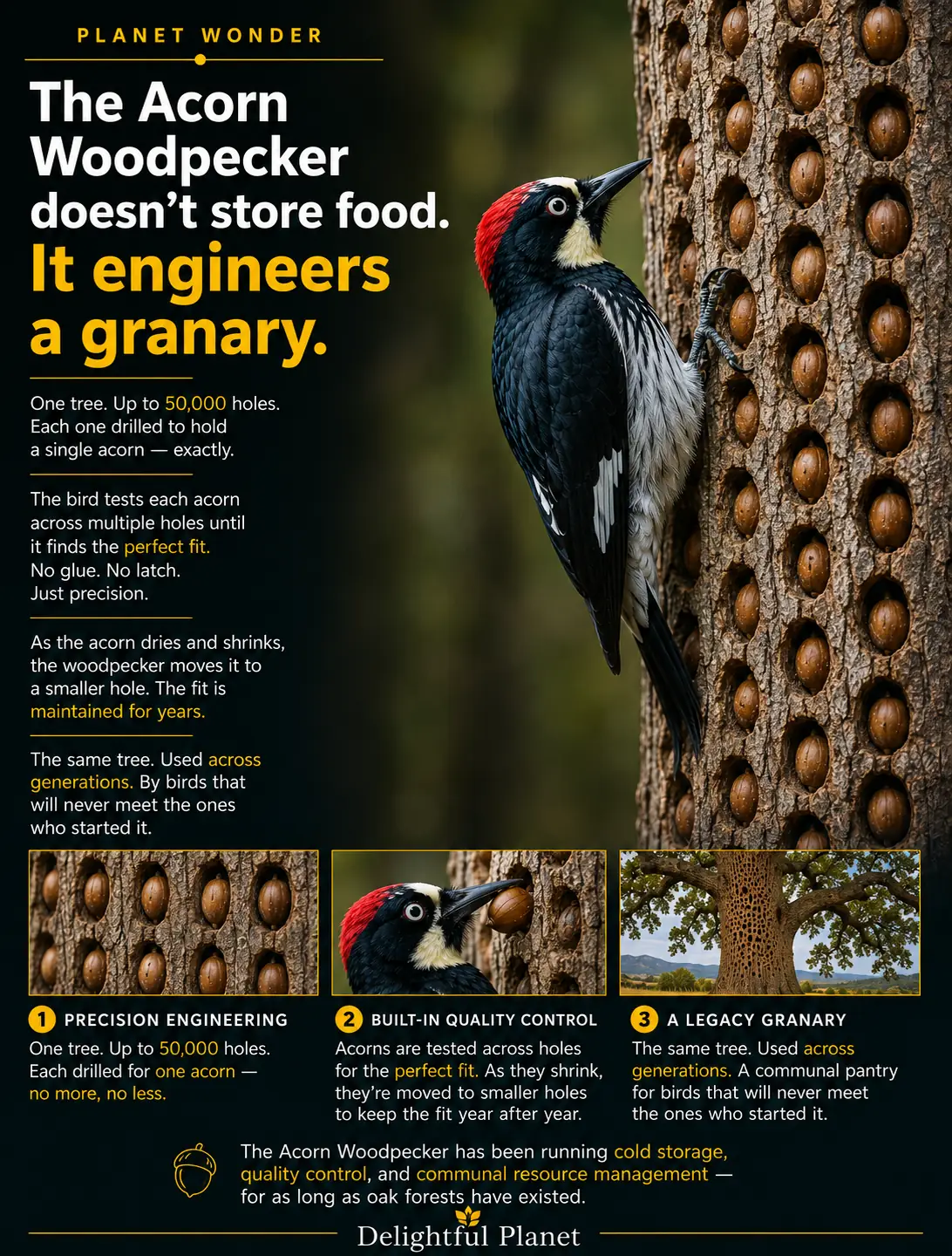
Walk through an oak woodland in California and you may stop at a tree that looks like it has been methodically taken apart from the outside. Thousands of small holes cover the bark from base to branch, each one plugged with a single acorn. The work is exact. The scale is almost architectural. And it is entirely the work of a bird that weighs around three ounces.
The mechanismThe Acorn Woodpecker does not simply cache food. It engineers a storage system with a precision that continues to operate long after the individual birds that built it are gone. Each hole is drilled not to a standard size but to match a specific acorn — tight enough that the acorn cannot be pried loose by a squirrel or lifted by a scrub jay, loose enough that the woodpecker can remove it cleanly when needed. Group members test each acorn across multiple holes until they find the fit. No glue. No latch. Just tolerance engineering in wood and shell.
The system has a maintenance protocol built into it. As stored acorns dry out over winter, they shrink. A hole that was a perfect fit in October becomes too loose by December. Group members conduct regular inspections — tapping each acorn, testing its snugness — and when the fit loosens, they move the acorn to a smaller hole. This continues through the season, the entire cache being progressively reorganized as the nuts contract. The granary is not a static deposit. It is an inventory under active management.
A single granary tree can hold up to 50,000 individually sized holes. The holes are drilled always into dead tissue — thick bark, dead limbs, snags — never penetrating the cambium beneath. Living trees are used as granary hosts regularly, but the drilling stays within dead bark, leaving the tree unharmed. New holes are added each year as needed, replacing those lost when limbs break off, while the older sections of the granary remain in continuous use.
Acorns make up roughly half the annual diet — insects are strongly preferred when available, but disappear in winter, leaving the granary as the group's primary food source for months at a time. The granary is not supplemental. It is what carries the group through. The precision of the fit is not aesthetic. An acorn that sits loose can be stolen; one that sits tight cannot. The difference between a well-fitted hole and a poorly fitted one is the difference between a reliable food supply and an open pantry.
A structure that outlasts any individual bird
Granary trees are used by successive generations of the same family group, with some trees in active use for decades. The holes drilled by birds that died years ago are still in service, still being managed, still holding acorns. Each generation inherits the structure, maintains it, and adds to it — drilling new holes each year to replace those lost as limbs break, without dismantling what came before.
The granary is valuable enough that when a breeding vacancy opens in a group that holds a large one, it triggers what researchers have documented as "power struggles" — intense, multi-day competitions in which coalitions of birds from neighboring groups fight to inherit the territory. The tree is, in the most direct sense, the group's most important asset.
The social structure that maintains the granary is itself unusual. Acorn woodpecker groups are cooperative breeders — typically two to eight breeding males and one to four breeding females, along with non-breeding helpers who are offspring from prior years. All members of the group participate in granary maintenance, acorn inspection, and territory defense. No single bird owns a hole or manages a section. The inventory is collective, and the labor of maintaining it is distributed across every member of the group.
This creates a system with a property that individual storage cannot achieve: redundancy. If one bird dies, the maintenance continues. If a section of the granary fails, the group repairs it. The knowledge of which holes are full, which acorns have been moved, and which sections need attention is not held by any individual — it is distributed across the group and renewed each season through collective behavior. The granary persists not because any one bird is exceptional, but because the system is larger than any of its members.
Engineers working on distributed storage systems — from warehouse logistics to fault-tolerant data networks — grapple with the same challenge: how to maintain a large inventory reliably when no single node has complete information. The woodpecker's answer is a group small enough to know each other but large enough to survive the loss of any one member, operating on a shared structure that accumulates value across time. The granary tree is the hardware. The group is the operating system. Neither works without the other.
The Acorn Woodpecker doesn't store food. It engineers a granary. And the birds managing it today are working in a structure their great-grandparents built.